 |
 |
||||||||
| Alexander the Great fourree stater,
5.7g (compared with about 8.6g for an official Alexander gold stater), copy of posthumous stater from Greece or
Macedonia, c. 310-275 BC, M.J. Price 831. This piece has small cracks in the gold plating that are somewhat visible in photo but are better seen in person. Its weight indicates that the base metal core is likely copper or perhaps a copper-lead alloy. It copies Price 831 fairly realistically. |
|||||||||
Coins have been counterfeited since the invention of coinage. Before coinage, pre-coin precious metal ingots were counterfeited as well. In ancient times, forgers typically counterfeited coins by plating a base metal core with a precious metal exterior, since the value of coins was tied to the value of their metallic content. Alexander fourree staters are known to have been created using two methods, with gold foil or gold leaf. With the
first, thin sheets of gold foil were wrapped around the planchet, burnished down, and hammer into place. With the
second, thinner gold leaf, perhaps in multiple layers, was applied and burnished down or applied over a mercury
solder and heated, burning off the mercury. In either case, the gold plating is thought to have been applied to
the blank planchet before striking. |
|||||||||
 |
 |
||||||||
Alexander the Great fourree stater,
5.1g. |
|||||||||
| Numismatists call ancient plated counterfeits fourrees, which is a term derived from the French word for "lined."
The word "fourree" is seen with alternate spellings, including the French "fourré,"
"fouree," "fourre," and "foure." Less frequently the Latin term "subaeratus,"
meaning "bronze beneath," is used. The existence of fourrees is the reason that many ancient coins have test cuts or banker's marks in them. To make sure coins received were made of good metal, people in ancient times would sometimes slash a coin with a chisel or designed punch to reveal the metal under the surface. |
|||||||||
 |
 |
||||||||
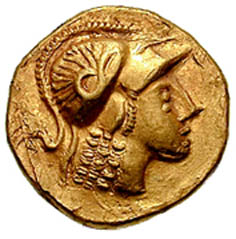
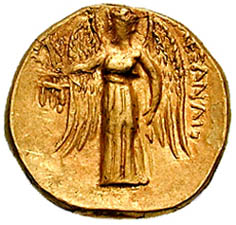
| Alexander the Great Thracian barbarous fourree stater, 9.1g, copy of possible lifetime stater from Amphipolis, Macedonia, c. 330-320
BC, M.J. Price 172 (this coin is also described elsewhere on this site). From the blocky rather than curvilinear styling, this "barbarous imitation" was likely made by a Thracian rather than a Celtic tribe. At 9.05g, this piece is overweight and undoubtedly has a lead interior in addition to it being slightly larger than official Alexander staters. I intended to buy this piece when it was sold by CNG but missed the auction. It sold there for $365. The French person who bought it put it up on eBay, and I bought it there for $202. Dumb luck. The French seller honored the transaction. This fourree is coated with thin gold foil rather than thicker gold plating, with the foil partly loose in a small area near the rim on the obverse at 7:30. A minority of ancient Greek-era gold fourrees were covered in thin gold foil, sometimes in multiple layers, instead of thicker gold plating. |
|||||||||
| Counterfeiting was a serious crime in ancient times, as it has been through most of history. In ancient Greece
and Rome, it was typically punishable by death, though if an aristocrat were caught he might have merely been exiled,
according to Ken Peters' 2002 book The Counterfeit Coin Story. Later, in Europe during the Middle Ages, various punishments for counterfeiters
were used. If you were lucky, you could have had your hand cut off, you ear cut off, your testicles cut off, or
been blinded. Or you could have been executed or first tortured then executed, by hanging, beheading, strangling,
drowning, boiling in hot oil, having molten lead pored down your throat, drawing and quartering, or breaking on
the wheel. In Colonial America, punishment for counterfeiting had become only slightly more humane. You could have gotten your ear cropped, your hand lopped, been branded, sentenced to life in prison, or hung. Counterfeiting in the U.S. today can be punishable by a fine of $5,000, up to 15 years imprisonment, or both, plus the seizure of any property used to create or pass the bogus bills (or coins), such as computers, scanners, and printers. |
|||||||||
 |
 |
||||||||
| Alexander the Great fourree tetradrachm,
13.9g (compared with about 17.0g for authentic specimens), copy of posthumous tetradrachm from Amphipolis, Macedonia,
c. 315-294 BC, M.J. Price 486. The large breaks in the silver plating, exposing the underlying copper/bronze, give this piece away. This fourree is particularly interesting in that it shows all three layers of a silver-plated fourree. The orange is the copper core, while the green is the "eutectic" layer separating the silver plating from the copper core. |
|||||||||
| Based on metallurgical testing, the "eutectic" layer consists of about 72 percent silver and 28 percent copper. It's unclear whether the eutectic layer was a hard silver and copper solder applied to help bond the silver plating to the copper core or was formed when the silver-plated planchet was heated, partially melting and interdiffusing the silver and copper. In either case, the plating is thought to have been applied to the planchet before the coin was struck -- otherwise the details of the design would have been compromised. | |||||||||
 |
 |
||||||||
| Alexander the Great fourree tetradrachm,
10.6g. The silver plating has completely corroded off this fourree. Fourrees today can have all of their plating intact, some of it, or none of it. The corrosive forces can come from within or without. Chemicals in the soil, water, and air (chlorides, sulfates and sulfides, carbonates, oxides, silicate, acids, and so on) can corrode the plating from the outside, and chemical-laden moisture and gasses seeping under the plating can further corrode it from the inside. |
|||||||||
| Fourrees are considered collectable by some, not all, collectors. They're ancient, but fake, the work of scammers
living a long time ago. Fourrees are almost always scarcer than the official issues they copy, but they generally
have a market value today of between 20 and 50 percent of them. With the exception of "Emergency Issue"
Athenian Owls struck during the tail end of the disastrous Peloponnesian War, all ancient Greek and Roman fourrees
are considered "unofficial," that is, not struck by ruling authorities, though in some cases official
dies may have been stolen or used on the sly by mint workers. It's likely that far more often counterfeiters made
fourrees from dies impressed from genuine coins or from newly engraved dies (in the latter case fourrees can some
appear crude and be mistaken for "barbarous imitations" made by tribal peoples). Sometimes fourrees are sold by dealers as official coins, their not knowing that the pieces are plated. Fourrees typically are lighter but not always, when for instance the interior copper is alloyed with lead or when the coin is thicker than an official issue normally is. |
|||||||||
 |
 |
||||||||
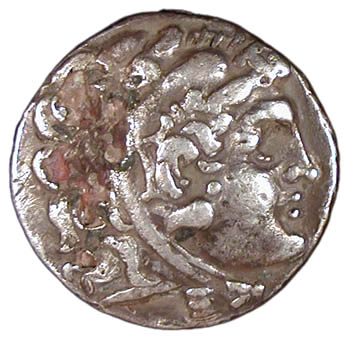
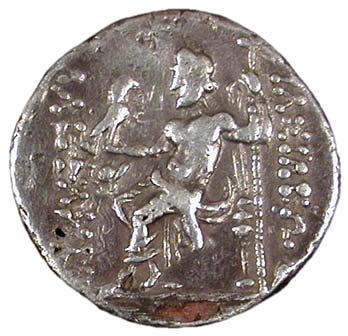
| Alexander the Great barbarous fourree tetradrachm, 14.4g (this coin is also described on the previous page of this site). This specimen exhibits large breaks in the silver plating on the obverse in the tufts of the lion scalp, exposing the underlying copper/bronze, and smaller breaks on the reverse under Zeus' throne. The degraded globularized legend most gives this piece away as tribal coinage. The round ends of letters are characteristic of imitative coins. This came about through the use of a bow drill, which the die cutter used to define the boundaries of the letter. Then he played connect the dots with a graver. The more skilled the die cutter, the less obvious the boundary dots. Barbarized coins struck by tribal peoples are often very globularized. |
|||||||||
Some collectors specialize in fourrees. Alan Emigh has an impressive collection of more than 150 ancient counterfeits of ancient Greek, Roman, and Celtic coins. Doug Smith has put together several interesting pages about ancient Greek and Roman fourrees from his collection. Here are other pages of mine on Ancient Fourree Counterfeits. |
|||||||||
 |
 |
||||||||
| Alexander the Great tetradrachm,
16.7g, posthumous tetradrachm from Amphipolis, Macedonia, c. 315-294 BC, M.J. Price 447 (this coin is also described
elsewhere on this site). The above is not a fourree but an official coin that was test cut in ancient times to see if it was a fourree. Because of the existence of counterfeit coins, in ancient times money changers, merchants, and others would take a chisel to coins to reveal whether or not the interior was good metal. Sometimes these cuts were in the obverse or reverse surface, sometimes the edge, as with the above specimen. Typically the result was only metal displacement, with negligible amounts of metal lost, so the weight remained the same. |
|||||||||
 |
 |
||||||||
| Alexander the Great fourree drachm,
3.0g (compared with about 4.2g for authentic specimens), copy of posthumous drachm from Kolophon, Ionia, Asia Minor,
c. 310-301 BC, M.J. Price 1827. This piece exhibits large breaks in the plating, particularly on the obverse. |
|||||||||
 |
 |
||||||||
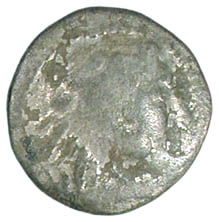
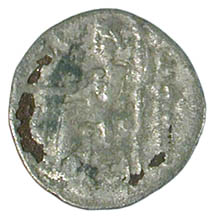
| Alexander the Great/Philip III barbarous fourree drachm, 3.4g (this coin is also described elsewhere on the previous page of this site). This ancient counterfeit, which has a blundered Philip III inscription, was likely struck by a Thracian tribe outside the Greek world. Another possibility though is that it was struck by an illiterate counterfeiter within it. It exhibits large breaks in the plating on the reverse. Along with being corroded, it's also worn, indicating it circulated. |
|||||||||
Other glomworthy coins:
Coin sites:
Coin Collecting: Consumer Protection
Guide
Glomming: Coin Connoisseurship
Bogos: Counterfeit Coins
Pre-coins
© 2013 Reid Goldsborough
Note: Any of the items illustrated on these pages that are in my possession are stored off site.