 |
 |
||||||||
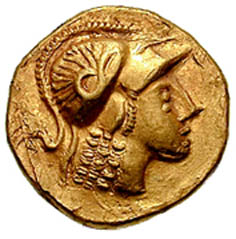
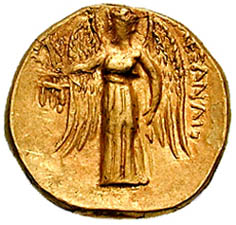
Thracian Alexander imitative fourree stater,
9.1g, Thrace, c. 4th to 3rd century BC, copy of possible lifetime stater from Amphipolis, Macedonia, c. 330-320
BC, M.J. Price 172 (this coin is also pictured elsewhere on this site). |
|||||||||
| Because of their widespread acceptance as money, many ancient coin types
were copied by ancient peoples and used as circulating currency. Those doing the copying included other cities
and rulers in the classical Greco-Roman world as well as tribal and urban peoples living at the periphery or outside
this world. Original works are generally regarded more highly than copies, as they should be. But copying, as the below coins illustrate, has always been a part of human activity. Imitative coinage represents in a tangible and enduring form the intersection of different cities-states and cultures, the borrowing of something from one by another and the alteration, and occasional improvement, of it. This is one of the agents of progress. |
|||||||||
 |
|||||||||
| Kolchis Alexander-style imitative gold stater, 4.2g (thin flan), Kolchis/Colchis, c. 200-150 BC, Lang Table I 5f (this coin is also pictured
elsewhere on this site). Alexander's staters were most commonly imitated outside of the Greek world by the Thracians and the Celts, to the north of Greece. The above coin was minted to the east, in Kolchis (Colchis). This region today is part of the Caucasus, also known as Caucasia, and corresponds to present-day Georgia, the former Soviet republic on the east coast of the Black Sea. In ancient times Kolchis was a fabulously wealthy land that was considered "the farthest voyage" according to an ancient Greek proverbial expression, the easternmost location in the known world, where the sun rose. Kolshis was also where, according to the mythology, Jason and the Argonauts sought the Golden Fleece and Prometheos was punished by having to perpetually push a rock up a mountain while an eagle ate at his liver for revealing to humanity the secret of fire. The Picassoesque styling of the above coin is similar to the numismatic art created by the best Thracian celators, not as intricate as that created by the best Celtic celators. The wildly abstracted and stylized head of Athena and standing Nike consist of simple geometric forms. The reverse inscription is made up of dots. The coin also has very pronounced edge lips on both obverse and reverse, with the relatively low-relief devices sitting deeply within the raised lips. Finally, the coin has a yellowish cast to it, likely indicating a relatively high silver content. All in all, this is one strange-looking coin. The coin's simplified styling isn't unique. In his posthumously published 1980 book The Coins of the Ancient Celts, D.F. Allen includes a specimen (no. 133) that exhibits the same linear as styling the above coin. Allen describes that coin as a strongly stylized first century BC Celtic coin from the Lake Constance area, which is on the border of Germany, Austria, and Switzerland. Further afield, the obverse is similar stylistically to Anglo-Saxon gold thrymsa of the seventh century AD. The artistic merits of coins such as these, whether or not they're evocative or crude, is debatable. It's clear though that it took less skill for a die engraver to execute lines and simple geographic forms than complex three-dimensional curves. Kolchis produced its own original coinage, most voluminously hemidrachms depicting an archaic female portrait on the obverse and a bull's head on the reverse (Sear Greek 3628). But many foreign coins circulated in Kolchis, including Alexander staters. The above coin was likely minted after the local supply of official Alexander-type coinage ran out, and judging from its severely barbarous style, some time after. Kolchis also produced imitations of Lysimachos staters and Augustan denarii. These Kolchis stater imitatives are rare and are not well documented. It's no doubt because they're not well documented that their market value is about the same or slightly less than official Alexander staters, which exist in quantities many orders of magnitude greater. I didn't find Kolchis imitatives documented in any of the SNGs, in BMC, or in any of the other collection catalogs/attribution references commonly used for Greek-era coins. They are referenced in a few more narrowly focused books and journal articles, including G.F. Dundua's 1987 book Numizmatika Antichnoi Gruzii, E.A. Pakhomov's 1970 book The Coins of Georgia, D.G. Kapanadze's article "Z historie gruzâinského mincovnictvâi" in Numismatické Listy Vol. 22, Nos. 5/6 (1967), David Lang's 1955 book Studies in the Numismatic History of Georgia in Transcaucasia, and the 1860 issue of Revue Numismatique. |
|||||||||
Many coin types issued after Alexander copied both the design and the inscription of his staters and tetradrachms. These are considered "posthumous" Alexander coinage when issued by ruling authorities in the classical Greek world, even if these authorities had nothing to do with the man, his legacy, or his homeland of Macedonia, which was frequently the case. These coins were often issued as a proclamation of freedom by newly independent city-states. Compared with Alexander's lifetime and early posthumous issues, these civic issues typically have a larger and flatter flan and are slightly lighter, which is characteristic of other late Hellenistic coinage. Though these coins are imitations, according to the common, nonnumismatic use of this word, I'm not covering them on this page (I've covered them in other pages of this site). In contrast to these posthumous Alexanders, coins that copied the Alexander design and inscription are considered "barbarous imitations," or imitatives, when issued outside the Greek world, typically by illiterate tribal groups, sometimes by urban non-Greek peoples. These coins typically diverged more, and more interestingly, from the standard Alexander designs. Alexander coinage was copied by, undoubtedly among others, Thracians to the north and east, Celts to the north and west, Kolchians and Arachosians to the east, and Samarians and Arabians to the south. With some late posthumous Alexanders from the Black Sea cities of Mesembria and Odessos, the boundary between official city coinage and barbarous tribal coinage becomes blurred. |
|||||||||
 |
 |
||||||||
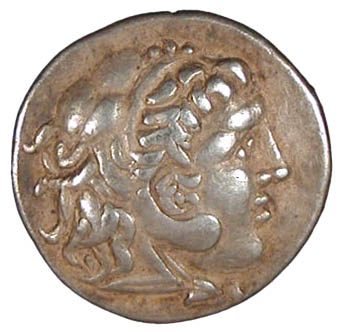
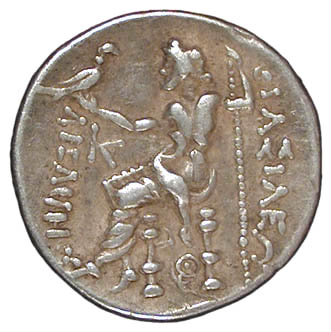
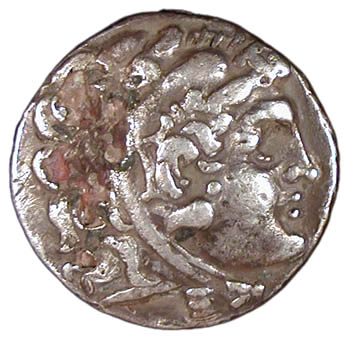
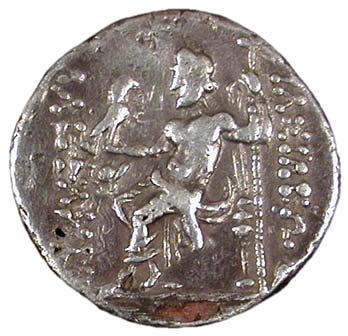
| Thracian Alexander imitative tetradrachm,
16.9g, Thrace, c. 3rd to 2nd century BC, Sear 210, copy of posthumous Alexander tetradrachm from Kallatis, Thrace,
M.J. Price 917. Most of the ancient imitations of Alexander coinage on the market today, which presumably corresponds more or less to the quantity in which they were minted, are imitations of the coins of Alexander's half brother, Philip III, which themselves are imitations of Alexander's coin types only with Philip's inscription instead of Alexander's. The above coin is an exception, imitating an Alexander tetradrachm. The blundered lettering in the reverse inscription is what most give this coin away as a "barbarous" imitation. The word "barbarous," meaning coarse or primitive, in this case does seem appropriate, though it doesn't with all imitations minted by tribal peoples or others outside the Greek or Roman world. The engraver of the above specimen no doubt was illiterate and copied the inscription from an original Alexander tetradrachm as a design element rather than as letters whose forms needed to be copied closely to be read and understood. |
|||||||||
| It's not clear whether the bulk of Alexander imitations struck north of Greece were struck by Thracians or Celts. Most often they're attributed as Celtic, but the Celts tended toward more curvilinear abstractions, as epitomized by their imitations and adaptations of earlier Philip II coinage. I believe it was the Thracians, whose abstractions were blockier, who imitated the bulk of later Alexander and Philip III coinage, though the likelihood exists that both the Thracians and Celts imitated Alexander/Philip III coinage. Some dealers acknowledge this uncertainty by attributing these coins to Danubian tribes -- both the Thracians and Celts lived near the Danube River, though the Celts spread much more widely to the west and north. The above Danubian imitative is a fairly close, and probably early, copy. | |||||||||
 |
 |
||||||||
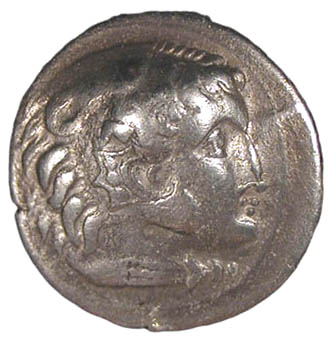
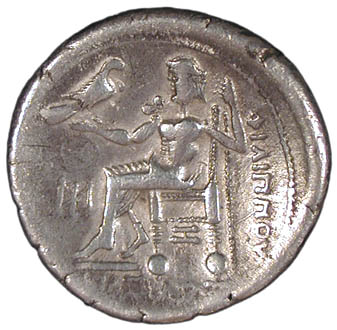
| Thracian Alexander imitative fourree tetradrachm, 14.4g, Thrace, c. 3rd to 2nd century BC. The above imitation is similar to the previous one, with a degraded inscription, though it's more "globularized" than on the previous coin. The round ends of letters are characteristic of many imitative coins. This came about through the use of a bow drill, which the die cutter used to define the boundaries and sometimes the midpoints of the letters. Then he played connect the dots with a graver. The more skilled the die cutter, the less obvious the dots. Barbarized coins struck by tribal peoples are often very globularized. Some official coins are somewhat globularized as well. This specimen is also an ancient counterfeit, silver plated over a based metal core. It exhibits large breaks in the plating on the obverse in the tufts of the lion scalp, exposing the underlying copper/bronze, and smaller breaks on the reverse in the exergue under Zeus' feet. |
|||||||||
The style of barbarous imitations is often degraded, but it's sometimes elevated, imparting to the original design an abstract, interpretative flair. Some collectors specialize in such coins, including Dave Liebl, who has an impressive collection of Celtic and Thracian coinage. Imitative coins typically sell for slightly less than the prototype coins they copy, particularly with the more commonly seen Thracian/Celtic types, but some imitative coins have a market value far higher. |
|||||||||
 |
 |
||||||||
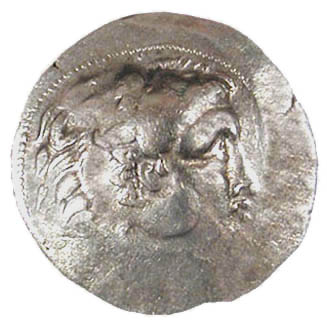
| Thracian Philip III imitative tetradrachm,
16.0g, Thrace, c. 3rd to 2nd century BC, Sear 212v., CCCBM 185, Lukanc Pl. 7 No. 2, Pink 581-583, copy of Philip
III tetradrachm from Arados, Phoenicia, M.J. Price P151. This and the next two coins are examples of the most commonly seen imitations of Alexander-type tetradrachms. They're actually copies of Philip III pieces, attempting as they do to copy his inscription as well. The above coin has a fully struck obverse and reverse. The specimens below represent varities in which only the obverse or reverse is fully struck. These coins have scyphate (cup-shaped) flans, with a sharply convex obverse and a concave reverse. The symbols in the reverse left field are a double-headed ax and sometimes a sun. Herakles on this type always has the same elongated nose. These coins are better documented than most imitatives, with the best English-language source I've found being Derek Allen's posthumously published 1987 Catalogue of the Celtic Coins in the British Museum, Vol. One: Silver Coins of the East Celts and Balkan Peoples, abbreviated as CCCBM. Other sources include Ivo Lukanc's 1996 book Les imitations des monnaies d'Alexandre le Grand et de Thasos and Karl Pink's 1939 book Die Münzprägung der Ostkelten und ihrer Nachbarn. |
|||||||||
| Along with Alexander coinage, other ancient coins that were widely imitated in this way include Athenian Owls; Philip II staters, tetradrachms, and drachms (prototypes of much Celtic coinage); Thasos tetradrachms; Roman Republican denarii, Claudius asses; Roman Imperial denarii of various emperors (prototypes of limes denarii); Claudius Gothicus and similar antoniniani (prototypes of barbarous radiates); and Constantinian bronzes. | |||||||||
 |
 |
||||||||
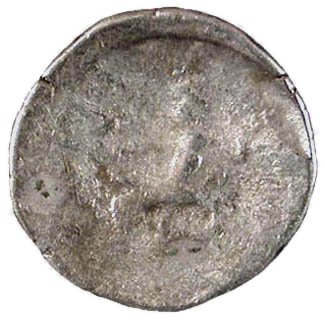
| Thracian Philip III imitative tetradrachm,
15.6g, Thrace, c. 3rd to 2nd century BC, Sear 212v., CCCBM 194, Lukanc Pl. 7 No. 4, Pink 584. The reverse of this Alexander-type imitative is weakly struck, which resulted from the use of a worn die. |
|||||||||
 |
 |
||||||||
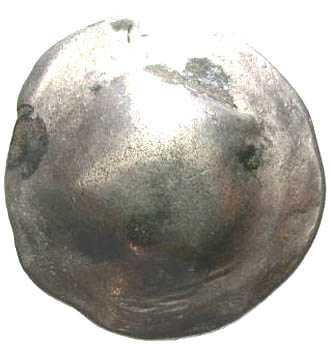
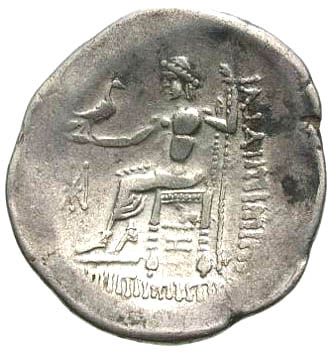
| Thracian Philip III imitative tetradrachm,
15.4g, Thrace, c. 3rd to 2nd century BC, Sear 212, CCCBM 198, Lukanc Pl. 7 No. 5, Pink 587. The obverse of this Alexander-type imitative is weakly struck and virtually featureless, which resulted from the use of a die worn down nearly to the point of destruction. The only feature faintly visible on the obverse is the hint of Herakles' nose. CCCBM illustrates four varities like this one. Robert Kokotailo has put forth a credible theory as to why these Thracian/Celtic Alexander imitatives exist in discrete states of degradation, as illustrated by the above three coins, rather than along a continuum of gradually decreasing degradation. He believes that the minters used an existing coin as a hub to create dies to strike new coins, a process that caused a loss of detail in the new coins. When more coins were needed and the existing hub coins and dies were no longer usable, one of the degraded coins was used as a hub to create other dies, leading to coins with still less detail. |
|||||||||
Alexander coins themselves borrowed from previous coinage, or perhaps from existing statuary. Some numismatists
feel that the Athena on Alexander's gold coins was based on the Athena of the coins of Corinth and that the Zeus
on his silver coins was based on the Baal of the coins of Tarsos. But others feel that these images were based
on public statues, since destroyed. The Nike on Alexander's gold coins may have been based on the Nike of the coins
of Olympia, where she symbolized victory at the games held there. It's clear that Herakles on Alexander's silver
and bronze coins was based on the same Herakles of previous Macedonian coinage, which in turn may have been based
on the Herakles of the coins of Kamarina, Sicily. The Herakles obverse and weapons reverse of Alexander's principle
bronze coins appeared earlier on other bronze coins, including Selinos and Thasos. Other pages of mine on coins copying Athens, Alexander the Great, Lysimachos, Parion, Thasos, Constantine the Great, and other coins can be found at my site on Ancient Imitative Coinage. |
|||||||||
 |
 |
||||||||
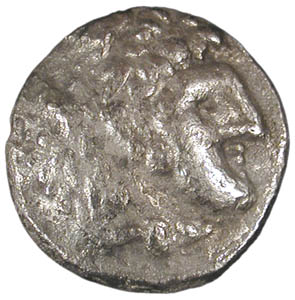
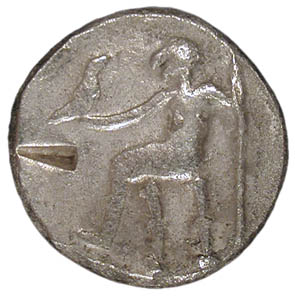
| Arachosian Alexander imitative tetradrachm,
16.3g, Arachosia, c. 3rd century BC. The above specimen represents a brand new type of Alexander imitative coinage, not known before the 21st century. Along with the rare Poros medallions, these Arachosian imitatives represent the farthest extent of Alexander's influence, nearly three thousand miles from Macedonia. In 2001 a hoard of about 230 ancient silver coins, 66 of which were Alexander imitatives, was unearthed from the area in western Pakistan and eastern Afghanistan known in ancient times as Arachosia, where it's believed these pieces were struck and used more than two thousand years ago. Unlike many hoards, this one was well recorded and photographed. Richard Miller, Arthur Houghton, and Catharine Lorber have done the most work with these coins, Miller in an upcoming catalog and Houghton and Lorber in the addenda of their 2002 book Seleucid Coins: A Comprehensive Catalogue. A coin dealer from Sweden bought all, or most, of the Alexander imitatives in Germany, and I bought the above specimen from him at the 2002 New York International Numismatic Convention. A California dealer bought a large group of these from the same dealer. The ANS also acquired a group, eight pieces, for its collection and documented them them in its American Journal of Numismatics 14 (2002). Subsequently, Ponterio & Assoc. sold a group of 11 of these coins in one of its public auctions. Undoubtedly this hoard has been dispersed in numerous other ways as well. These imitatives are believed to have been struck in Arachosia during the 3rd century BC and to have been buried around 200 BC, after the end of Seleukid control of the area, by the Greek settlers who remained. These coins were likely used in the area after the use of official Alexanders and Baktrian imitations of Athenian Owls and before the beginning of official Baktrian coinage under Diodotus I c. 256 BC, with other coins likely used as well. Arachosia was part of the Persia Empire from the time of Cyrus the Great in the middle of the sixth century BC to the time of Darius the Great, who Alexander the Great defeated in two battles in 333 and 331 BC. Alexander marched through Arachosia in 329 BC. After Alexander's death in 323 BC, Arachosia became part of the Seleukid Empire. It was subjected to the Indian emperor Ashoka Maurya during the middle of the third century BC, the Bakrian kingdom in the late third century BC, and the Parthian kingdom in the second century BC. The obverse of the above specimen depicts a crude portrait of Herakles with a large nose that's common among imitative coinage in general. Four of the coins in the hoard, not this one, depict an obverse portrait that's a hybrid between the Herakles portrait on Alexander's coins and the Alexander portrait on Lysimachos' coins. The reverse of this specimen depicts a crude Zeus with an even more exaggerated nose. There's no inscription, as with most of these coins, though some of the coins in the hoard have a degraded inscription. These coins typically are corroded, and many have test cuts. Three of the coins in the hoard have silver plugs in them, perhaps where test cuts had been. I bought the above specimen partly cleaned, with unsightly black streaks of silver sulfide on the obverse. Further cleaning improved its appearance. Some of the coins in the hoard were said to have been roughly cleaned before arriving in Europe. The above piece is on a round flan, is well centered, seems to be of good silver, and as an imitative is fairly pleasing overall despite the obverse roughness and reverse test cut. |
|||||||||
 |
 |
||||||||
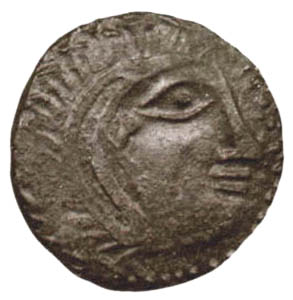
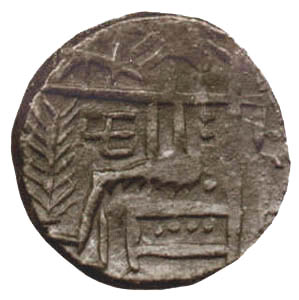
| Arabian Abi'el-type Alexander imitative tetradrachm, 16.0g, Eastern Arabia, c. 1st century BC, Potts Class XLVII (particularly No. 424, and
No. 387 of the supplement), SNG Cop. Supplement 1236. This coin is an example of another very interesting class of Alexander imitative coinage, minted to the south of Macedonia in eastern Arabia along the Persian Gulf, a region that traded with the Greeks, minted official third century BC Alexanders, and later minted abstracted imitatives. Unlike the above Arachosian imitatives, these Arabian imitatives have been known since at least the late 19th century when Barclay Head documented such a tetradrachm in the 1880 issue of Numismatic Chronicle. The above specimen has many striking features. On the obverse, Herakles' frontal eye is reminiscent of Athena's almond-shaped eye on archaic and classical Athenian Owls. The rendering of the eye on the above coin could represent an "all-seeing, all-knowing eye" with religious significance, an eye similar to the large eye of the Eye Goddess of Neolithic peoples, which originated in the Middle East, an eye that conveys supernatural perspicacity. Or it could be the product of an archaizing art technique that that deliberately harkened back to earlier times in which this frontal eye treatment was common. A third possibility is that it's the result of lost knowledge of how to create realistic perspective. The earlier Arabian imitatives have the more realistic profile eye of official Alexander coinage, while the later more abstracted imitatives typically, though not always, have the archaic frontal eye. I believe an eye such as this, so prominent in the overall design, must have been created deliberately to convey meaning important to those using this money, and that this meaning, as with much iconography on coinage, was religious. As with many Arabian Alexander imitatives, on the above specimen Herakles' nose and mouth, as well as his eye, are overlarge. The chevrons, or zigzag lines, that make up the lion's mane extend down to his neck, and the lion's open mouth atop Herakles head has morphed into a curved horn, perhaps patterned after the Horn of Ammon (ram's horn) on Lysimachos and other coinage. On the reverse, the rendering of Zeus is also interesting. He's a stick figure with a bird-like face and arms that are lines running perpendicular to his torso, which is defined by two lines. The eagle perched on his right arm has transformed into a stick-figure horse, which is characteristic of the more abstracted Arabian imitatives. The symbols in front of him, common to this type, are a three-pronged anchor, perhaps patterned after a Seleukid anchor, and a stylized palm tree. The inscription has mostly disappeared. On earlier, less abstracted Arabian imitatives of this type, the inscription is in Aramaic and reads "Abi'el." Abi'el was a king who likely ruled during the late 3rd or early 2nd century BC in southeastern Arabia in an area that corresponds to present-day United Arab Emirates. This specimen is in all likelihood derived from those coins -- an imitation of an imitation. By its color, it's likely made of darkly toned billon, a silver alloy with a high percentage of copper, as the later abstracted imitatives typically were. The coin has a narrow flan but is thick, which accounts for its weight. Coins such as these have been found in Mleiha, a district in the emirate of Sharjah in the United Arab Emirates, as well as north of this in areas within the Eastern Province (Ash Sharqiyah) of Saudi Arabia and within Kuwait. These coins are thought to have been struck and used two millennia ago in the same areas of eastern Arabia along the western shore of the Persian Gulf. The best attribution source for Arabian Alexanders is D.T. Potts' 1991 book The Pre-Islamic Coinage of Eastern Arabia and its 1994 supplement. Potts believes these imitatives were minted in eastern Arabia into the first century AD, but given the spread of Roman coinage, it may be safer to date them slightly earlier. Besides Abe'el, Arabian Alexander imitative types were minted by other Arabian rulers during the 3rd to 1st century BC, such as Abyatha. Sometimes Arabian Alexanders are identified in the literature by the tribe thought to have minted them, such as the Agraeans, or by the area where they were found and were likely minted, such as Thadj/Gerrha, Filaka/Ikaros, and Bahrain/Tylos. |
|||||||||
 |
 |
||||||||
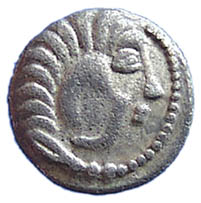
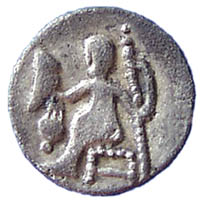
| Thracian Alexander imitative drachm,
2.8g, Thrace, c. 3rd to 2nd century BC, Sear 211v., CCCBM 215, Lukanc Pl. 4-5 No. 46-66, Pink 577-578. Alexander-style imitative drachms from north of Greece exist in a number of interesting varities. With the above variety, it's unclear whether the coin is a copy of an Alexander or Philip III prototype since there's no inscription. Unlike the bulk of Philip III imitative tetradrachms and drachms, however, the flans of the above type are not scyphate (cup-shaped). Lukanc and Pink attribute this type as an Alexander imitative. This is creatively executed imitative type, with a particularly evocative obverse. The lion's mane consists of swirling tufts that artistically merge into the coin's dotted border. The abstracted open lion's mouth, now rendered as two facing curves in the middle of the design, adds to the smartly contoured design. Conversely, the reverse design is as cloddish as the obverse is elegant, with a big-nose, bottom-heavy Zeus perched awkwardly on his throne. |
|||||||||
 |
 |
||||||||
| Thracian Philip III imitative drachm,
3.5g, Thrace, c. 3rd to 2nd century BC, Sear 211v., CCCBM 204, Lukanc Pl. 7 No. 8. This Thracian drachm imitative type is characterized by the same elongated nose as many of the Thracian tetradrachm imitatives. One distinctive element is the treatment of the eyes on both Herakles and Zeus. The globules surrounded by deep recesses impart a dramatic abstract effect. |
|||||||||
 |
 |
||||||||
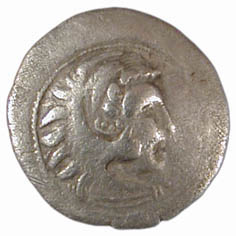
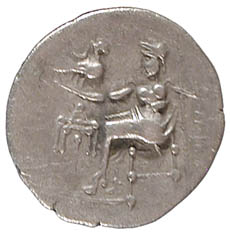
| Thracian Philip III imitative drachm,
2.8g, Thrace, c. 3rd to 2nd century BC, Sear 211v., CCCBM 207, Lukanc Pl. 7 No. 12. This type is characterized by a deeply concave/convex flan and Zeus' exaggerated pectoral muscles, created by globules that impart a feminine appearance to his chest. Herakles on the obverse is rendered fairly realistically. |
|||||||||
 |
 |
||||||||
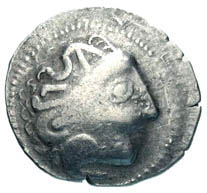
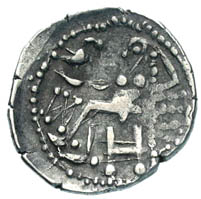
| Thracian Philip III imitative drachm,
2.6g, Thrace, c. 3rd to 2nd century BC, Sear 211v., CCCBM 213, Lukanc Pl. 7 No. 11. Here's a variety with an evocatively stylized obverse and reverse. Herakles' hair takes on the appearance of the snakey locks of Medusa, and he has an archaic frontal eye. Zeus has the same globularized, feminine chest as the previous coin, though his head here is abstracted as well. |
|||||||||
 |
 |
||||||||
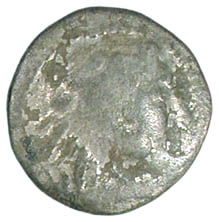
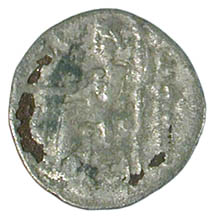
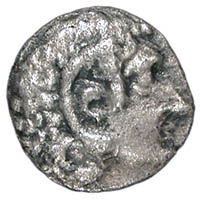
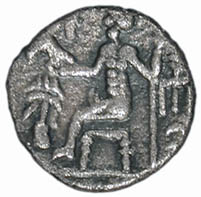
| Thracian Philip III imitative fourree drachm, 3.4g, Thrace, c. 3rd to 2nd century BC (this coin is also pictured elsewhere on this site). This ancient counterfeit, which has a blundered Philip III inscription, was likely struck by a Thracian tribe outside the Greek world. Another possibility though is that it was struck by an illiterate counterfeiter within it. It exhibits large breaks in the plating on the reverse. Along with being corroded, it's also worn, indicating it circulated. |
|||||||||
 |
 |
||||||||
| Arabian Abi'el-type Alexander imitative drachm, 3.8g, Eastern Arabia, c. 2nd century BC, Potts Class S4 (No. 286 this coin). This imitative drachm comes from south of Macedonia in eastern Arabia. It's probably an ancestor to the Arabian Alexander tetradrachm illustrated above and the Arabian Alexander obol illustrated immediately below. The iconography is more realistically rendered, though it's the same Abi'el type. All three of these coins are likely descendants of the same very realistically rendered coins minted by King Abi'el during the late 3rd or early 2nd century BC. This specimen has a "horn" that distinctively hooks over Herakles' ear. Other distinctive elements, to the reverse right, are a three-pronged anchor that faces down and two crescents underneath them. Zeus' abdominal muscles are particularly well defined, and he appears to be crossing his legs. His face is simply rendered as hair, nose, and chin. This coin, likely an earlier imitation, appears to be made of silver. |
|||||||||
 |
 |
||||||||
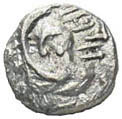
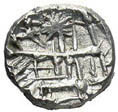
| Arabian Abi'el-type Alexander imitative obol, 0.78g, Eastern Arabia, c. 1st century BC, Potts Class XLVII, SNG Cop. Supplement 1239. The above beautifully abstracted Alexander Arabian obol is is in the same Potts class as the Alexander Arabian tetradrachm pictured on this page. But there are some interesting differences. On the obverse, Herakles' eye is now defined by two parallel lines rather than an almond-shaped border. On the reverse, Zeus' head is rendered as a sunburst, with spikes of hair coming out of a featureless face, which may represent the solar deity worshipped by the pre-Islamic people of the area. The horse he's holding on his right arm is rendered with more detail. And his breasts appear as two globules. Unlike the tetradrachm, this obol appears to be made of silver rather than billon. Potts identifies some of these abstracted obols as being made of silver, some of billion. |
|||||||||
 |
 |
||||||||
| Thracian Alexander imitative bronze,
AE-16, Thrace, c. 3rd to 2nd century BC. Unlike the barbarous imitations of Alexander the Great's precious metal coinage, the barbarous imitations of his base metal coinage are poorly documented, as are bronze coins in general since they're generally regarded as being less impressive than silver or gold coins. I haven't found any of these bronze imitatives documented anywhere. The bronze imitatives are not as common as the silver or gold imitatives, but they're not rare either. I bought the above specimen from a Bulgarian importer for just $20. This and the next specimen are likely coins minted by Thracians living north of Greece in lands that correspond to present-day of Bulgaria. As with many imitatives in general, what most distinguishes the Herakles portrait on the obverse of these two pieces is the overlarge nose. But the reverses are distinctive as well, the iconography being completely blundered. With official Alexander bronzes of this type, a quiver (arrow case) rests on top of a bow. With these two imitatives, the quiver divides the bow in half, indicating the die engraver didn't understand what he was supposed to be engraving. The club beneath the bow has unrealistically large nodules in it. |
|||||||||
 |
 |
||||||||
| Thracian Alexander imitative bronze,
AE-18, Thrace, c. 3rd to 2nd century BC. This bronze imitative is similar to the previous one, though the nose is so large that it may have been engraved to be deliberately comical. With this piece, the bow is now divided into not two but three different pieces. |
|||||||||
Other glomworthy coins:
Coin sites:
Coin Collecting: Consumer Protection
Guide
Glomming: Coin Connoisseurship
Bogos: Counterfeit Coins
Pre-coins
© 2013 Reid Goldsborough
Note: Any of the items illustrated on these pages that are in my possession are stored off site.