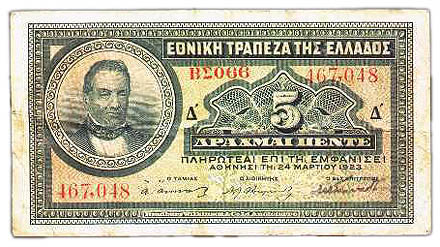
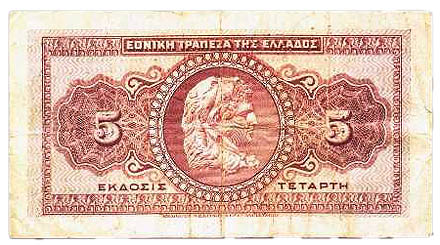
1923 Greek 5 drachmas note (Pick 70). Obverse: Georgios Stavros, first governor of the National Bank of Greece. Reverse: Alexander image from Tarsos medallion. Issued by the National Bank of Greece and printed by Bradbury Wilkinson & Co. This not was issued shortly after the "Asia Minor Catastrophe" in 1922, part of Greco-Turkish War from 1919 to 1922, in which Greece gained and then lost territory in eastern Thrace and western Asia Minor.
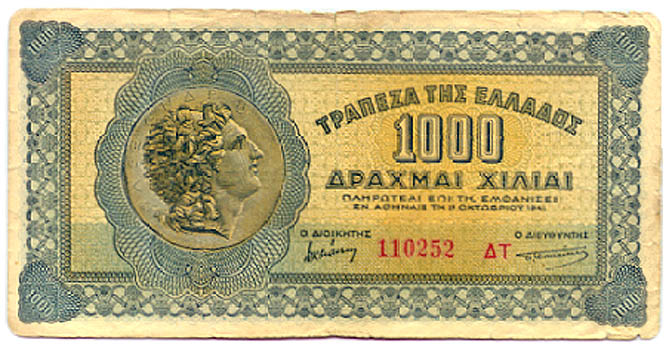
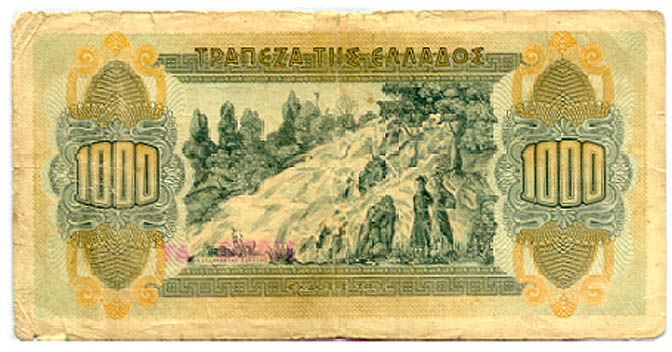
1941 Greek 1000 drachmas note (Pick 117). Obverse: Alexander image from Aesillas tetradrachm. Reverse: Edessa Falls. Issued by the Bank of Greece. Greece and Italy waged war in 1940 and 1941 during the Greco-Italian War.
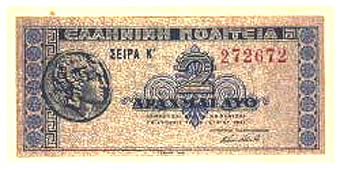
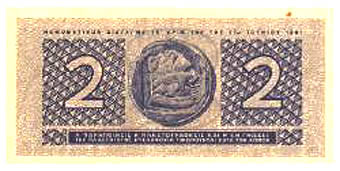
1941 Greek 2 drachmas note (Pick 318). Obverse: Alexander image from Lysimachos tetradrachm. Reverse: Carian drachm. Issued under German occupation. In 1941 Germany occupied much of Greece after the Battle of Greece.
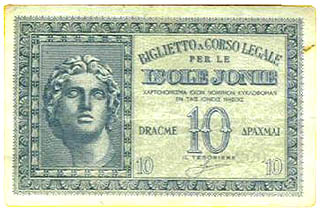
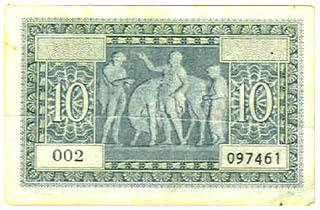
1942-43 (undated) Ionian Islands 10 drachmas note (Pick M13). Obverse: Alexander image from British Museum sculpture. Reverse: Sculpture from Parthenon. A 5 drachmas note with the same design also exists. These notes were issued under Italian occupation by Mussolini during World War II, with Italy, Germany, and Bulgaria each occupying part of Greece.
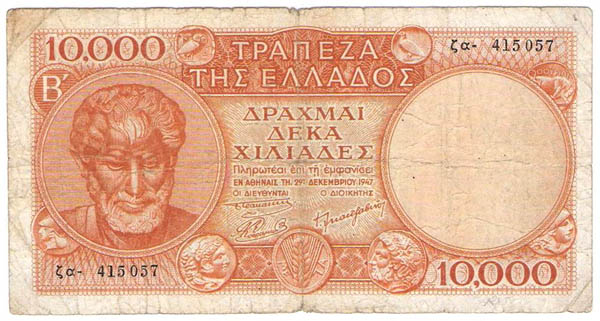
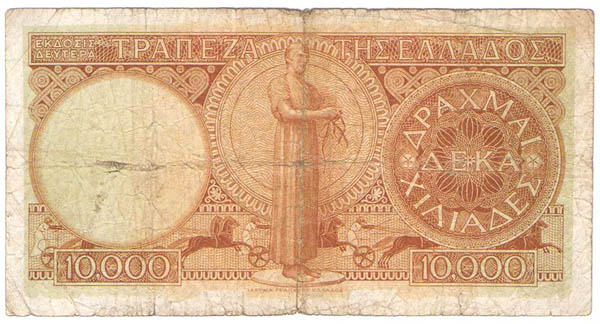
1947 Greek 10,000 drachmas note (Pick 182). Obverse: Bust of Aristotle, eight ancient Greek coins that from their style don't appear to be illustrated to scale, clockwise from upper left Athenian Owl tetradrachm, Akragas didrachm, Lucania stater, Alexander III stater, Philip II tetradrachm, Metapontion stater, Alexander III tetradrachm, and Corinthian stater. Reverse: Statue of the Charioteer of Delphi from the early Classical period, a famous life-size bronze statue erected in 474 BC, unearthed in 1896, and residing in the Delphi Archaeological Museum. The figure is outfitted with a long garment worn by charioteers called a xystis and an athlete's headband called a taenia, and he holds reins in his right hand. The left arm of the statue is missing. Similar notes in the same denomination were issued earlier in 1947 (slightly smaller) as well as in 1946 and 1945, and after revaluation of the drachma, a similar 10 drachmas note was issued in 1954. These notes were issued during a period of high inflation in Greece following World War II during the Greek Civil War of 1946 to 1949.
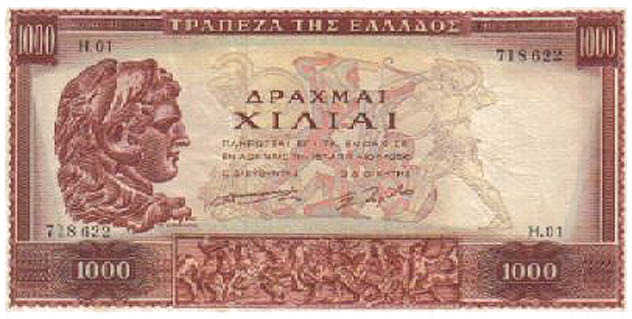
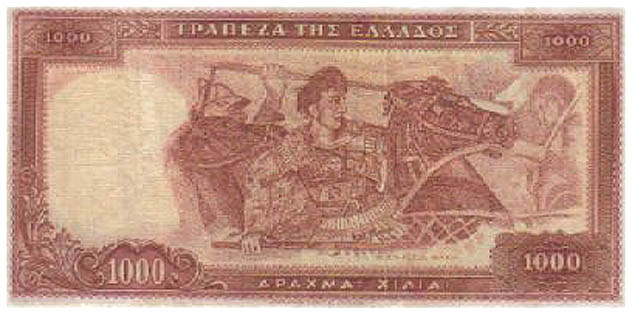
1956 Greek 1000 drachmas note (Pick 194). Obverse: Alexander image from Tarsos medallion. Reverse: Alexander on his horse Bukephalos attacking Darios, the Persian Great King, at the Battle of Issos. This scene is part of the "Alexander Mosaic" that was uncovered in Pompeii, Italy, and resides in the National Archeological Museum in Naples, Italy. It's thought to be a Roman copy of a late 4th century BC Macedonian fresco. This note was issued during a period when Greece was governed by a succession of conservative parties. It circulated in Greece until 1975.
Not pictured
1921-22 50 drachmas note (Pick 66). Obverse: Alexander on his horse Bukephalos striking a Persian soldier at the Battle of Issos. This scene is part of the "Alexander Sarcophagus," a stone coffin decorated with sculpture that was uncovered in Sidon, Phoenicia, is dated 325-300 BC, and resides in the Archaeological Museum in Istanbul, Turkey. Reverse: Alexander image from Aesillas coin. Printed by American Bank Note Company.
1918 2 drachmas note (Pick 307). Obverse: Perikles wearing Corinthian helmet. Reverse: Lysimachos tetradrachm. Printed in Corfu.