|

|
 |
| |
|
Greek Coin Circle gold-plated silver unmarked replica of an Alexander III distater, 13.1g (compared with about 17.2g for an authentic
Alexander gold distater).
This replica was made for the Greek Coin Circle, a collectors group in Thessaloníki, Greece, though it was
incorrectly described by the eBay seller, who was from Greece, as a stater replica instead of a distater replica.
It copies Price 191, a lifetime coin from Aegeae. The piece is the correct size for a distater but is lightweight
and gold plated, and it exhibits glossy, mirror-like surfaces and indistinct details caused by the plating. It's
unmarked with "COPY" or a similar designation on the surfaces or edge. |
|
|
| |
|
|
|
|
| |
|
|
|
|
|
|
|
|
|
| |
|
Unlike forgeries, coin replicas, also called reproductions or repros, aren't
created with a clear intention to deceive. Sure, they can be schlocky knockoffs, but they can also be interesting
variations on a theme, honoring the coin they copy. The U.S. Mint does this, in fact, with its American Eagle series
of gold and silver bullion coins that copy the Saint double eagle and the Walking Liberty half dollar and the Buffalo
commemorative dollar that copied the Buffalo nickel.
Many private mints in the U.S. and abroad do this as well, with ancient, world, and U.S. coins, with those making
replicas of ancient coins including Antiquanova, Gallery Mint Museum, Charlton Mint, Westair Reproductions, Alva
Museum Reproductions, Museum Reproductions, and the Greek Coin Circle.
Museums have also sold ancient coin replicas, including the British Museum, the Smithsonian Institution, the Metropolitan
Museum of Art, and the J. Paul Getty Museum. Schools have done the same, including the Barber Institute of Fine
Arts in Birmingham, England. And companies have done so as well, including the magazine and book publisher Newsweek.
And there are individual replica makers, in the U.S. and abroad, who have specialized in ancient coin replicas,
including the American Peter Rosa and the Bulgarian Slavey Petrov. |
|
|
| |
|
|
|
|
|
|
|
|
|
|
 |
| |
|
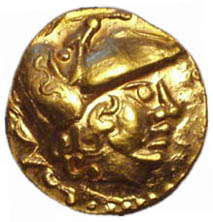
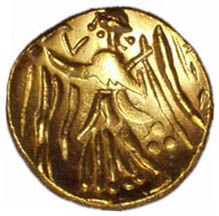
Antiquanova pressed replica of an ancient Celtic Alexander III imitative stater issued by the Moravian Boii tribe during the 2nd century BC,
6.95g, .986 gold. |
|
|
| |
|
|
|
|
| |
|
|
|
|
|
|
|
|
|
| |
|
The Czech replica maker Antiquanova makes some of the best ancient coin replicas in the world, marking them unobtrusively
on the reverse with an S countermark for Petr Sousek, the engraver, though the countermark isn't apparent in this
photo, which is Antiquanova's, my not having this piece in my possession. The oversmooth, polished look of the
surfaces give this piece away. It sells for $174 (recently sold for $159), both prices being not inexpensive for
a gold replica (Antiquanova's silver and base-metal replicas are priced more attractively). |
|
|
| |
|
|
|
|
|
|
|
|
|
|
|
 |
| |
|
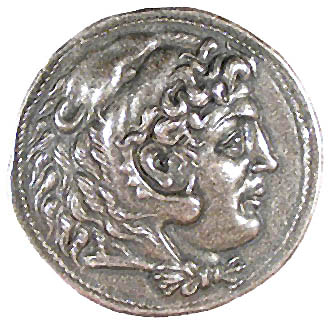
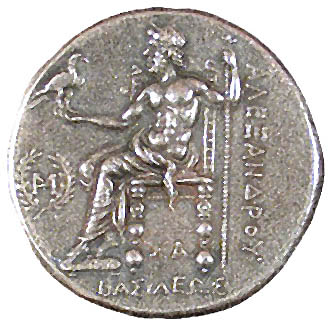
Slavey pressed replica of an Alexander III tetradrachm, 16.9g (correct weight). |
|
|
| |
|
|
|
|
| |
|
|
|
|
|
|
|
|
|
| |
|
Slavey Petrov is one of the three great ancient coin replica makers in the world active over the past half century,
with the other two being Antiquanova and Peter Rosa. Slavey replicas typically make their way to market through
fellow Bulgarians, who put them up for sale on eBay or sell directly to customers. Frank Robinson sells them as
well through his auctions, as do some other U.S. dealers.
Slavey's work is stylishly flamboyant, as the above piece illustrates. It's a copy of Price 3730, a posthumous
issue from Babylon. But it's not a slavish copy.
The defining characteristic of this Slavey replica is Herakles' thin-lipped smile, which is part smirk and part
scowl and is different from the smile on authentic Alexander tetradrachms from Babylon. Herakles also sports dark
circles under his eyes, which give him a world weary look. The tight curls in the lion's mane atop Herakles' head
are uncharacteristic of Price 3730, or for that matter any of the other 132 Babylon tetradrachms that Price illustrates.
The flan is also wider and flatter than authentic Babylonian issues. As with much of Slavey's work, the fields
are flatter and more regular than on authentic coins, a result of the high-pressure hydraulic press he uses to
transfer the designs from die to planchet, which contrasts with the ancient practice of hand striking using a hammer.
As the ancients did, however, Slavey engraves his dies by hand rather than using machine tools. For his Greek silver
replicas Slavey uses .950 silver, which is a slightly less pure alloy than used with most archaic and classical
ancient Greek coins. This particular replica is countermarked with "COPY" on the edge; not all of his
work is, particularly his earlier work. More on Slavey replicas. |
|
|
| |
|
|
|
|
|
|
|
|
|
|

|
 |
| |
|
Counterfeit of a Slavey replica of an Alexander III tetradrachm, 16.7g (this piece is also pictured elsewhere on the site). |
|
|
| |
|
|
|
|
| |
|
|
|
|
|
|
|
|
|
| |
|
Because replicas are less expensive to obtain than authentic ancient coins, forgers sometimes use them as host
or seed coins in creating their deceptions. The above forgery is such an example. It's a copy of the previous Slavey
replica. The flan is shaped more convincingly irregular, the beaded borders on the obverse and reverse are different,
and the piece has been artificially worn and toned. The reverse also the result of a slightly different die than
the previous Slavey replica, though Slavey has made more than one die of his popular replicas. It's not clear from
the photo whether the above piece is an actual Slavey replica that has been worked on, a cast of such a replica,
or a struck or pressed copy made from a cast die.
The piece is periodically sold as an authentic coin by an eBay seller from Germany. This seller has been selling
forgeries as authentic coins in significant quantity on eBay since July 2004. |
|
|
| |
|
|
|
|
|
|
|
|
|
|
|
 |
| |
|
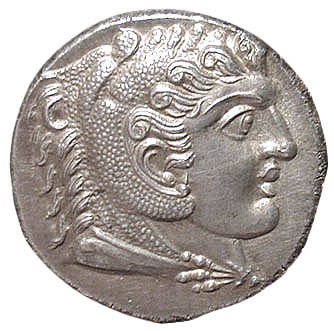
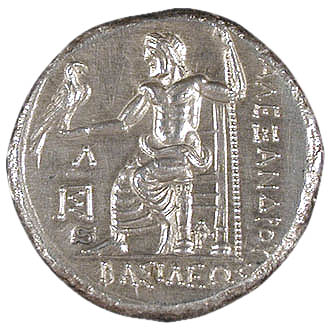
Antiquanova pressed replica of an Alexander III tetradrachm, 17.1g. |
|
|
| |
|
|
|
|
| |
|
|
|
|
|
|
|
|
|
| |
|
This is a replica of Antiquanova, also known as Ancient Coins & Artifacts Reproductions, a company run by Pavel
Neumann and Petr Sousek in the Czech Republic. Antiquanova makes replicas of many ancient Greek and Roman coins,
and other coins as well. Their work is high quality, with hand engraved dies (by Petr Sousek) and minting with
a screw-operated press. They're efficient in servicing orders, but they don't always respond to email questions.
Antiquanova replicas of silver coins are available in .999 silver (such as this one), .925 silver (sterling silver),
or tin, with the replicas made of tin being less expensive than the ones made of silver. Antiquanova countermarks
its replicas on the reverse, relatively inconspicuously, with an S incuse, which stands for Sousek. With this specimen,
you can see the S in the reverse left field above Zeus' foot.
Though Antiquanova does quality work, some of its work is necessarily of higher quality than other. The above replica,
a copy of Price 3320, a possible lifetime tetradrachm from Arados, isn't one of its better efforts, with styling
that's blocky rather than organic and an obvious replica look to its surfaces. It cost $16 in 2001 and currently
is priced at $27 (or $8 in tin). |
|
|
| |
|
|
|
|
|
|
|
|
|
|
|
 |
| |
|
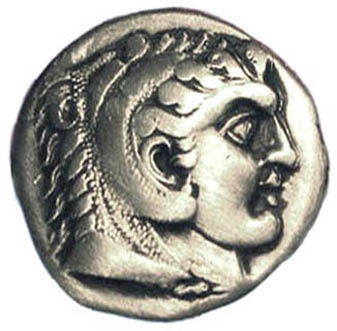
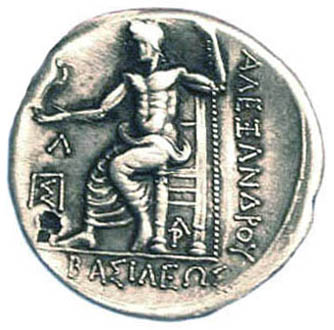
Tooled Antiquanova replica of an Alexander III tetradrachm, weight unknown. |
|
|
| |
|
|
|
|
| |
|
|
|
|
|
|
|
|
|
| |
|
This is another example of how knowing the common replicas out there can help with counterfeit detection. It's
a tooled version of the same Antiquanova replica pictured before it. Someone gauged out the S countermark from
the reverse left field, which you can see in the picture as two dark spots under the mint mark. The piece has also
been artificially worn. A seller put it up on eBay as an authentic coin, and when it was brought to his attention
that it was a tooled replica, he contended that he had bought it as an authentic coin from a local dealer, though
he did take the auction down.
By having been transformed from a replica not meant to deceive into a work of deception, even if an amateurish
one, this piece is now a modern forgery. In an online photo authenticity test I conducted, four of fifteen people
who responded felt this was an authentic ancient coin, not recognizing either the gouge marks or the Antiquanova
styling. |
|
|
| |
|
|
|
|
|
|
|
|
|
|
|
 |
| |
|
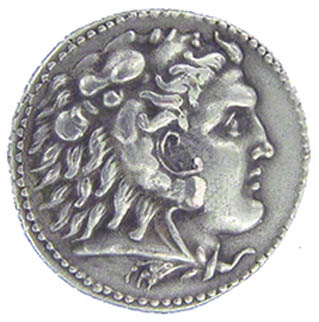
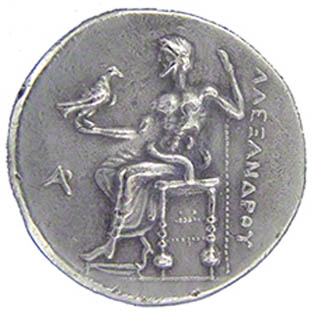
Rosa cast replica of
an Alexander III tetradrachm, 10.5g. |
|
|
| |
|
|
|
|
| |
|
|
|
|
|
|
|
|
|
| |
|
The third great ancient coin replica maker of the past half century was Peter Rosa, who's important not because
of the quality of his work but because of his notoriety. Rosa's story is best documented in Wayne Sayles' 2001
book Classical Deception,
and his catalog of Rosa replicas is comprehensive though not complete (the above replica, for instance, isn't in
it). Herbert Klug is a collector who has also studied Rosa's work in detail and offered information about it.
In short, most of Rosa's replicas are casts of casts, that is, of casts that the British Museum made of the authentic
ancient coins and the Becker forgeries in its holdings, which the museum sold to Rosa. Carl Wilhelm Becker, a German
who worked in the early 19th century, is history's most notorious ancient coin counterfeiter, a collector who started
making fakes after having gotten stuck with one himself, eventually sticking the seller who stuck him. Becker also
fooled many of the world's most prominent museums. Rosa named his company after the German forger, using the name
Becker Manufacturing Co. then later Becker Reproductions Inc. In addition to creating cast copies, Rosa also created
dies from these casts and pressed out copies with them.
Rosa made his replicas out of a variety of different metals, including silver, though he primarily used a silver-plated
lead and antimony alloy. His replicas didn't necessarily conform to the weights of the authentic coins. He marked
some of his replicas on the edge with "COPY," some with "BECKER," some with the British Museum
catalog number, and some with his own catalog number. After the passage of the U.S. Hobby Protection Act in 1973,
Rosa stopped marking his replicas out of protest, in violation of the law, feeling that its requirement that coin
replicas be marked on the obverse or reverse would deface them.
Most of the Rosa replicas on the market today, like the above piece, are products of a former employee of Rosa,
Charlie Doyle, who uses the eBay I.D. chas051 and who calls his company Museum Coin Reproductions. Doyle says he
bought some of Rosa's molds, made in the 1960s, from Rosa's twin brother after Rosa's death in 1990 to help keep
his legacy alive, and that most but not all were still usable. (Sayles, who has donated Rosa's dies and his collection
of Rosa replicas to the ANS, contends he bought all of Rosa's molds as well.)
Doyle uses a silver-plated lead-free pewter (tin alloy with smaller amounts of other metals such as antimony and
copper). He marks his copies, which he sometimes describes as Rosa replicas, sometimes as Becker replicas, on the
edge with "COPY." His casts are the correct size, but they're very lightweight, and he doesn't mention
the weight in his auctions. Doyle does good work as a replica maker, and the above piece, though it has a casty,
mushy appearance to it, particularly the reverse, is well toned and attractive enough.
The Charlton Mint also makes marked ancient coin replicas based on Rosa's work, but in its case it made its own
molds from the Rosa replicas it owned, and its cast replicas, which are copies of copies of copies (third-generation
copies), consequently have less detail. Nick Mavrostomos, an eBay seller from Canada using the I.D. *nt*ancients,
also uses Rosa's work to make his own marked cast replicas, in his case the Rosa replicas that Doyle sells (Mavrostomos
also makes marked cast replicas from Slavey and Antiquanova replicas as well as from authentic ancient coins).
The above Rosa replica is a copy of the Becker forgery documented in George Hill's 1924 book Becker the Counterfeiter as No. 47. That
forgery, as is this replica, is a copy of a possible lifetime tetradrachm from Byblos, Price 3426. |
|
|
| |
|
|
|
|
|
|
|
|
|
|
|
 |
| |
|
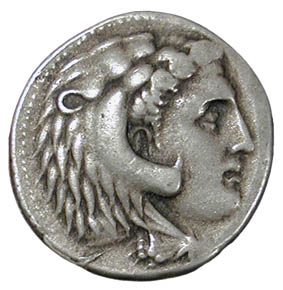
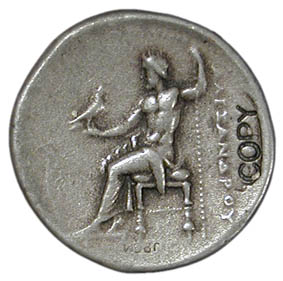
J. Paul Getty Museum cast replica of an Alexander III tetradrachm, 7.0g.
This is an example of a museum replica, sold by the J. Paul Getty Museum in Los Angeles, Calif. Unlike some other
museum replicas, such as some of those sold in the past by the Metropolitan of Art, it's marked, in its case with
a large incuse "COPY" on the reverse and a small "JPGM" upside down under Zeus' throne. It's
slightly small at 24mm and very lightweight at 7.0g, and it looks to be made of pewter. It's a copy of a posthumous
tetradrachm that Price attributes loosely to Western Asia Minor, Price 2718. |
|
|
| |
|
|
|
|
| |
|
|
|
|
|
|
|
|
|
| |
|
Some collectors like replicas, while many look down at them. Dealers typically don't like them because there's
little margin in selling them, and this negativity gets passed on to collectors. Replicas can be very collectible.
The best of them capture the beauty of ancient coins without the history, though the background of some replicas
can be quite interesting. Collecting an inexpensive replica of an expensive ancient coin is similar to hanging
on your wall an inexpensive poster of an expensive oil painting. Collecting a range of replicas can be an interesting
way to see various modern interpretations of ancient coins.
Many replica collectors prefer their replicas unmarked with "COPY" or a similar designation or inconspicuously
marked so as not to interfere with the coin's design. But according to the U.S. Hobby Protection Act, it's illegal
to make or import replicas made after the law's passage in 1973 that aren't marked conspicuously with "COPY"
in large capital letters on the obverse or reverse (not the edge), though it's not illegal to sell or buy them
once here. This law doesn't appear to have ever been enforced with regard to ancient coins, however, with no reports
of unmarked replicas ever having been seized. The law has had two effects. Numismatic publications now no longer
accept ads for replicas not marked in accordance with the law. And museums no longer sell unmarked replicas of
ancient coins in their gift shops. Replica makers in other countries are under no obligation to adhere to the U.S.
law regarding replicas. |
|
|
| |
|
|
|
|
|
|
|
|
|
|
|
 |
| |
|
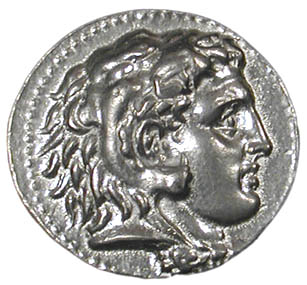
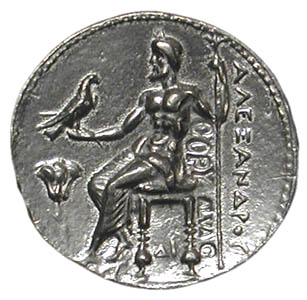
Alva Museum cast replica of an Alexander III tetradrachm, 11.4g. This replica, from Alva Museum Reproductions of Old Bethpage, N.Y., is an example of a commercial replica made
by a replica company that uses the word "museum" in its name but is not a museum. It's an attractive
replica, though slightly small and very lightweight, and appears to be made of some kind of white metal alloy.
It's countermarked on the reverse with "COPY ALVA" and copies a lifetime tetradrachm from Memphis, Price
3971. |
|
|
| |
|
|
|
|
| |
|
|
|
|
|
|
|
|
|
| |
|
Replicas can not only be interesting in themselves, they can also help with counterfeit detection. Knowing the
common replicas out there of ancient coins can help you spot fakes because, being less expensive to acquire than
authentic coins, they're often used by forgers as host/seed coins in making cast fakes or in making cast dies for
struck or pressed fakes. Spotting the style of a Slavey or Lipanoff piece can tip you off that a piece offered
as authentic is false. |
|
|
| |
|
|
|
|
|
|
|
|
|
|
|
 |
| |
|
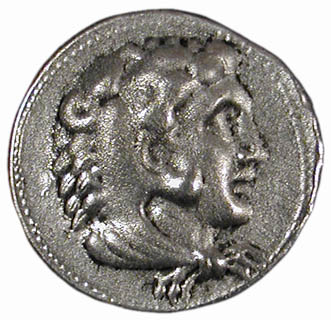
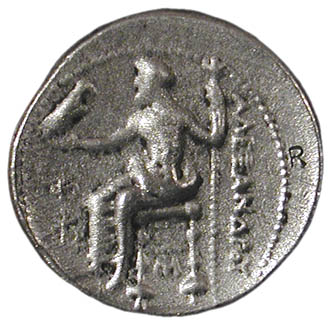
Museum Reproductions cast replica of an Alexander III tetradrachm, 13.8g.
This is another replica from a commercial replica maker with the word "museum" in its name, Museum Reproductions of Cheshire, United Kingdom. This isn't a high-quality copy, though it's priced
inexpensively. It has indistinct details, large casting pits over the coin's surfaces, and remnants of a casting
seam on the edge, and it's described as being made from "a lead-free metal." The piece is countermarked
on the reverse with "R" and copies a lifetime tetradrachm from Myriandros, Price 3231. |
|
|
| |
|
|
|
|
| |
|
|
|
|
|
|
|
|
|
| |
|
Sometimes the line separating replica and forgery isn't clear. The Lipanoff Studio in Bulgaria appears to make
some unpatinated silver-plated copies that are clearly not meant to deceive and some patinated solid silver copies
that are, or perhaps others are patinating the solid silver copies that they make. |
|
|
| |
|
|
|
|
|
|
|
|
|
|
|
 |
| |
|
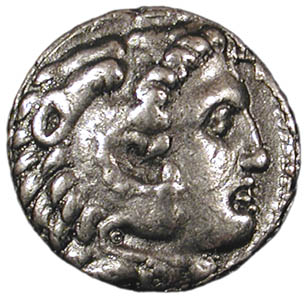
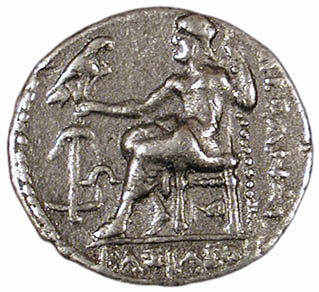
Charlton Mint cast replica of an Alexander III tetradrachm, 13.7g.
This replica is from the Charlton
Mint of Saratoga Springs, N.Y., which makes affordably priced
sets of ancient coin replicas. This piece is made of pewter and copies a posthumous tetradrachm from Arados, Price
3359. |
|
|
| |
|
|
|
|
|
|
|
|
|
|
|
 |
| |
|
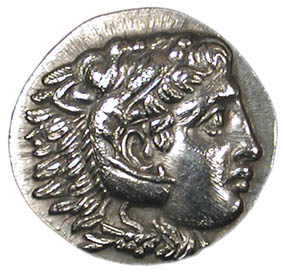
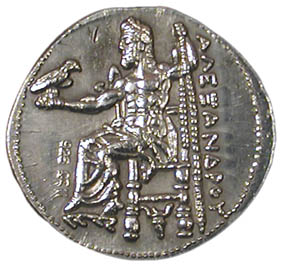
Greek Coin Circle silver replica of an Alexander III tetradrachm, 10.9g.
Like the distater replica pictured at the top of this page, this piece was made for the Greek Coin Circle, a collectors
group in Thessaloníki, Greece. It's made of sterling silver and is marked as such -- 925 -- on the reverse.
It's small and lightweight but otherwise is attractively rendered. This replica copies a possible lifetime tetradrachm
from Pella, Price 218. |
|
|
| |
|
|
|
|
|
|
|
|
|
|
|
 |
| |
|
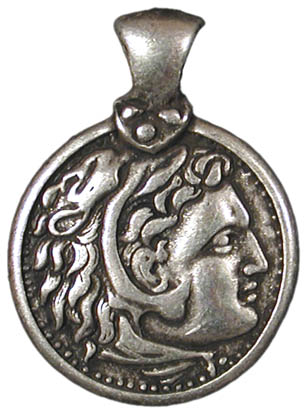
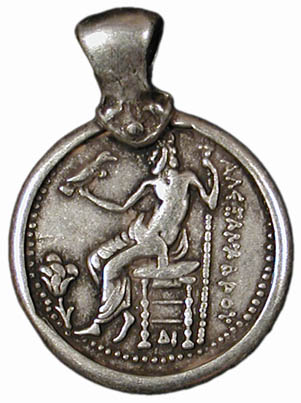
Greek jewelry replica of an Alexander III tetradrachm.
Here's another replica made in Greece, this one with a jewelry clasp bolted to it. I bought it from John Papadakis
of GreekCrafts.com. It's pewter and copies, inexactly, a lifetime tetradrachm from Memphis, Price
3971. |
|
|
| |
|
|
|
|
|
|
|
|
|
|
|
 |
| |
|
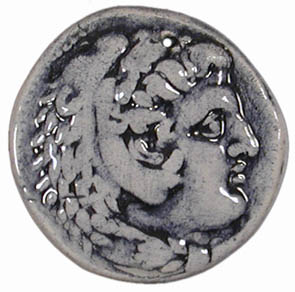
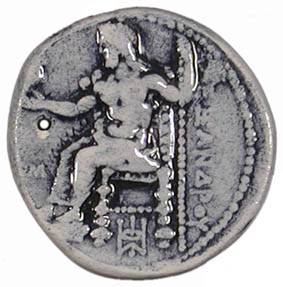
Turkish jewelry replica of an Alexander III tetradrachm.
Here's another jewelry replica, this one a ceramic copy made in Turkey. The hole in it appears at the top of Herakles'
head and in the reverse left field. It was created by Bekircan Tahberer of Sandan Art.
It copies a lifetime tetradrachm from Babylon, Price 3666. |
|
|
| |
|
|
|
|
|
|
|
|
|
| |
|
|
|
|
|
| |
|
|
|
|
|
|
|
|
|