 |
 |
||||||||
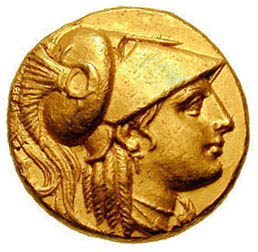
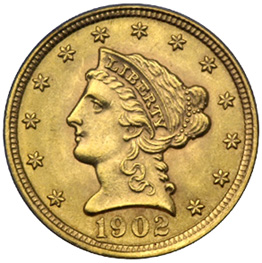
FACE OFF On the left, Alexander the Great lifetime gold stater minted in Abydos, Asia Minor, c. 328-323 BC, 17mm in diameter, 8.6g in weight, .997 fine gold, depicting the ancient Greek goddess Athena. On the right, U.S. 2-1/2 dollar gold piece (quarter eagle) minted in Philadelphia, Pennsylvania, in 1902, 18mm in diameter, 4.2g in weight, .900 fine gold, depicting the modern U.S. "goddess" Liberty (photo of quarter eagle courtesy of CoinFacts.com). |
|||||||||
| Alexander's staters, like his tetradrachms, were the principle denomination,
but in gold instead of silver. These can be stunningly beautiful coins, intrinsically radiant, speaking with a
bright voice about how humankind through the ages has prized gold above all other metals. Like the tetradrachms,
the staters also depict two symbols of strength, but instead of two male gods they're adorned with two female gods.
The obverse depicts a strong and beautiful Athena, goddess of wisdom and warfare, who would eventually morph into
Roma, the patron goddess of Rome. The reverse depicts Nike, goddess of victory, with spectacular body-length wings,
who would eventually morph into a Christian angel. Athena wears a crested Corinthian helmet, which may have been chosen as an allusion to Alexander's position as head of the Corinthian League and his hegemony over Greece. Many scholars have speculated that the Athena on Alexander's staters was based on the Athena of the coins of Corinth. A.R. Bellinger in his 1963 book Essays on the Coinage of Alexander the Great felt that it was more likely that it was based on the Athena of Athenian Owls. But the coins of Velia among others also depicted a helmeted Athena. Athena may have been modeled after the huge bronze statue of Athena Promachos by Pheidias at the Athenian Acropolis. Athena's helmet is pushed backward, with the eye holes and nose piece at the top of her head. In combat, the helmet would be pushed forward, covering the soldier's face. The Corinthian helmet is the most common helmet to appear on ancient Greek coins, also appearing on among other coins Corinthian staters and Mesembrian diobols, followed by the Attic helmet, appearing most commonly on Athenian Owls. The crest of the Corinthian helmet, when it had a crest, was made of horse hair, with bristly short hair at the top and long tail hair at the end, as illustrated on these coins. The helmet on these coins is typically ornamented with a coiled snake, a symbol of Athena, which is typically the coin's highpoint and the first area to show wear. Nike wears a diadem (headband) and long chiton (tunic). Alexander's Nike may have been based on the Nike of the coins of Olympia, where she symbolized victory at the games held there. Another possibility, as with Athena, is that Nike was modeled after statuary at the Athenian Acropolis, in this case the small gold Nike statues there. Otto Mørkholm in his 1991 book Early Hellenistic Coinage: From the Accession of Alexander to the Peace of Apamea (336-188 BC) presented a persuasive argument that Alexander chose both obverse and reverse iconography on his gold coins as a friendly gesture toward Athens, Greece's greatest city. This would not have been the first time that Alexander made gestures of reconciliation such as this. In her right hand, Nike holds a laurel wreath, which is a symbol of victory. In her left hand, with most of these coins, she holds what some scholars interpret as a stylis (part of the stern of a Greek ship), others a ship's mast. In either case, the stylis/stern likely alludes to Greece's great naval victory over Persia at the Battle of Salamis c. 480 BC, one of the epochal moments in history, allowing Greece -- Western civilization -- to continue its embryonic experimentation with democracy, individualism, rationalism, and the separation between political and religious authority. Some scholars, on the other hand, have interpreted the stylis to refer to Alexander's naval victory over the fleet of Tyre in 332 BC, but this is less likely because it requires Alexander to have begun minting staters of his own type four years after his ascension. Completing the reverse are the inscription, which translates into "Of Alexander" or "Of King Alexander," and usually a mint mark or marks as well, which may be in the form of pictures, symbols, or letters. |
|||||||||
 |
|||||||||
| Alexander the Great lifetime stater, 8.61g, official
issue from Abydos, Asia Minor, c. 328-323 BC, M.J. Price 1497. This beautiful gold coin is representative of Alexander the Great's conquering the Persian Empire, the mightiest the world had yet seen, and his attempt to unite East and West, Persia and Greece. To promote this effort of cultural fusion, Alexander dressed as a Persian, adopted Persian ways, directed his soldiers to marry Persian women, and appointed Persians to high administrative positions. This effort was cut short by is death, possibly by malaria, in 323 BC at about the age of 33. Since then, the chasm between East and West has increased. Had Alexander succeeded long term, beyond the empires of the Persians, the Seleukids, the Romans, the Byzantines, and the Ottoman Turks -- no small feat -- there would be no need for a war on terrorism today. Abydos, where this coin was in all likelihood minted, was the closest Greek city from Europe on the Asiatic bank of the Hellespont (Dardanelles) in present-day Turkey and the location where Alexander crossed into Asia in 334 BC. It had been previously freed by Alexander's father, Philip II, through an advance force he sent into Asia in 336 BC, shortly before his assassination and Alexander's ascension to the throne. Alexander's first major victory over the Persians during his invasion of Asia was the Battle of the Granikos River, which took place along the road from Abydos to Daskyleion. Abydos was earlier settled by Thracians and then by Greek colonists from Miletos before falling under the rule of the Persians from c. 384 to 336 BC. Martin Price expressed caution in attributing these and other Alexander issues to Abydos, though others before him attributed them this way as well, including Margaret Thompson, Alfred Bellinger, and Edward Newell. Newell appears to be the first to have done this, but it's not clear what he based this attribution on, and this is likely the reason for Price's caution. The figure of a male wearing a chlamys (small cloak fastened at the shoulder) in the reverse left field and the Greek letter xi under Nike's right wing, marks of the mint magistrate, appeared on other similarly styled staters, tetradrachms, and drachms attributed to Abydos (Price 1496-1502, 1514-1515). Other cities used xi as a mint mark, but only Abydos seems to have used the male wearing chlamys figure. The specimen also depicts Athena with tightly braided hair, hair over her left shoulder, a pedant earring, and a double-strand beaded necklace. |
|||||||||
| The tetradrachms are known for their great variety, but the staters varied
stylistically as well during their run, if not as dramatically. As with the tetradrachms, the face of Athena changes,
in some cases picking up what are likely features from Alexander's own face and appearing decidedly more masculine,
as with the specimen above from Miletos. Athena's hair is visible as tight braids, coifed curls, or loose locks;
sometimes strands appear to the right side of her helmet, sometimes above her left shoulder, sometimes in neither
place. Sometimes Athena wears a pendant or stud earring, sometimes no earring; most times she wears a single-strand
beaded necklace, sometimes a double-strand beaded necklace, sometimes no necklace. Athena's helmet also changes. Most commonly it's adorned with a snake, which is a symbol of Athena. But the helmets of some posthumous staters from Asia Minor, Babylonia, and Phoenicia feature a gryphon, a mythological beast with the head of a bird, the body of a lion, and wings, which the Greeks regarded as an enemy of the Persians and may have symbolized the destruction of Persian power. Another variant features a helmet with a winged lion that's sometimes horned. The rarest variant features a helmet with a sphinx. Sometimes Nike's left leg is straight; other times it's slightly or significantly bent, rarely at an angle of more than 45 degrees but sometimes up to about 60 degrees (see Price 1526). One anomalous variety, Price 2644 from Sardes, depicts Nike facing right instead of left. Nike is typically svelte, but on some varieties she looks as if she could be pregnant (see Price 797). The tops of Nike's wings are usually rounded, sometimes pointed. On some posthumous Alexander staters from Miletos and Tarsos, two tiny Nikai sit atop the crossbar of the stylis on the reverse, though these Nike figures are sometimes off the flan. On other posthumous staters from Miletos and Seleukia, the stylis is replaced by a palm. On still others, it's replaced by a trident. Price believed that design variations such as these were whims of individual die cutters. Alexander staters in the British Museum holdings were minted from 19 cities during his lifetime, 33 cities in all, on three continents. This compares with 23 cities that minted lifetime Alexander tetradrachms and 87 cities that minted Alexander-style tetradrachms during and after his lifetime. As with tetradrachms and drachms, most were minted in Asia, 65.9 percent, compared with 27.8 percent in Europe and 4.3 percent in Egypt, based on the holdings of the British Museum. Price was uncertain of the region with 2.0 percent of the staters. The six most prolific cities in minting staters were Sardes (28), Sidon (24), Amphipolis (21), Abydus (21), Miletos (21), and Babylon (21). Price illustrated 349 official Alexander staters, compared with 1,269 official tetradrachms and 434 official drachms. With 7.7 percent of the British Museum stater holdings, Price couldn't attribute the coin to a specific city. As with the other denominations, he also illustrated some barbarous staters and some modern forgeries. As with the tetradrachms and drachms, most staters are posthumous, 61.9 percent. In contrast, 21.8 percent of staters are lifetime issues and 16.3 percent are varieties that were issued both during and after his lifetime. A higher percentage of staters, 38.1 percent, are lifetime or possible lifetime than tetradrachms, 28.0 percent, or drachms, 14.3 percent. Like Alexander-style drachms, the staters continued to be minted after Alexander's death but not nearly as long as the tetradrachms. Unlike the tetradrachms, which were used as commonly accepted international currency, the staters were largely replaced by local gold coinages. The last Alexander-style staters were issued in the Black Sea cities of Odessos and Sinope c. 200 BC. In contrast, posthumous Lysimachos staters, featuring Alexander's portrait, were minted into the first century BC in the Black Sea region. As is discussed in the Ancient Imitations section of this site, some rulers and regions in the Greek world imitated both the obverse and reverse of Alexander's stater design but used their own inscription, including Philip III, Lysimachos, Seleukos I, Demetrios Poliorketes, Antigonos Gonatas, Pyrrhos, Oxyartes of Baktria, and Mithradates II of Pontos. Others issued silver or bronze coins that borrowed the obverse and reverse design of Alexander's staters. Like the tetradrachms, Alexander staters were also imitated by peoples outside the ancient Greek world and sometimes changed dramatically in appearance, as is demonstrated by the specimens illustrated below from Thrace and Kolchis. Other Alexander stater imitatives were issued by the Celts. The Romans likely used Alexander's Athena iconography as a model for the helmeted Roma on third century BC coinage, with Roma sometimes even wearing a Corinthian helmet decorated with a coiled snake (other early Roman coins depict Roma wearing a Phyrgian helmet, the type that Alexander himself wore in battle). The Romans also borrowed Alexander's Nike iconography, but by the time of Theodosius II in the early fifth century AD, Alexander's winged Nike standing left and holding a laurel wreath had transformed into a winged Christian angel standing left and holding a cross. |
|||||||||
 |
|||||||||
| Alexander the Great posthumous stater, 8.6g, official
issue from Miletos, Asia Minor, c. 323-319 BC, M.J. Price 2095, SNG Cop. 633. The Athena on the obverse of this coin is more masculine than on the previous coin, with larger cheekbones and a longer face. Some scholars believe that just as with some of Alexander's silver imperial coinage, Alexander's facial features have been subtly introduced to the Athena image on some of his gold imperial coinage. On this specimen, the fierce gaze and pursing lips are reminiscent of the Alexander portrait on Lysimachos tetradrachms. Athena on this specimen also has loose wavy hair, a single-strand beaded necklace, and no earring. The reverse of this posthumous stater features as mint control marks an ear of corn (grain) and a double-headed ax, the latter being a symbol of Zeus and a representation of power. The double ax probably originated in Sumer, the world's first civilization, and was used as both an agricultural tool and weapon, according to Marvin Tomeanko. Because it had two heads, it could be used longer before it needed to be resharpened. Alternatively, each edge could be used for different purposes, a sharp one for cutting, for example, and a blunter one for digging or chopping. Double-bitted axes are still used today for the same reasons. The Romans called the double ax a "bipenis," a frequently seen but confusing term used in the numismatic literature. The double ax was also displayed on ancient Greek and Roman Provincial coins as a symbol of Dionysos, in which case it was accompanied by a bunch of grapes or an amphora (wine jug). Miletos, where the above specimen was minted, was a Greek colony in Asia Minor settled before 1000 BC that itself established numerous other colonies throughout the Greek world, more than 90 in all. Miletos was prosperous and prominent, and in the sixth century BC, it was one of the first Greek cities to mint coinage. In the fifth century BC, shortly before this coin was minted, Athens adopted the Milesian alphabet, which became the Greek standard. The city was prominent during the Roman era as well but declined after its harbor silted up during the Christian era. |
|||||||||
| Price indicates that the weight of Alexander staters, both lifetime and posthumous,
didn't change much, that it was tightly controlled as a result of the high intrinsic value of gold. Most, according
to Price, are around 8.55g, with all but a relatively small percentage weighing between 8.62g and 8.48g. Price
acknowledged that his sample size was small. Weight is an important factor in judging authenticity. Price's analysis didn't take into consideration the Alexander staters from the Black Sea cities of Callatis, Istrus, Mesembria, Odessus, Lysimacheia, Sestos, and Synope, plus the four specimens he attributed only broadly to the Black Sea region. The vast majority of those weigh less than 8.48g, 35 of 48 specimens illustrated by Price, or 81.4 percent. What's more, about a fourth, 25.6 percent, weigh less than 8.40g. Of the other cities minting Alexander staters, Miletos had the highest percentage weighing less than 8.48g, 6 of 21 or 28.6 percent. The above figures, as well as the figures below, discount specimens that are holed, clipped, broken, or plated. The lightest stater from the Black Sea region, Price 904 from Callatis, weighs 8.30g. The lightest from Asia Minor, Price 2276A from Teos, weighs 8.36g. No staters from Macedonia, Greece, Syria, Phoenicia, Babylonia, Media, Susiana, or Egypt weigh less than 8.40g. From Asia Minor, 2 of 162 weigh less than 8.40g and 1 of 23 from Cyprus weighs less than this. If you take into consideration all official Alexander staters except those from the Black Sea region, 7.3 percent weigh less than 8.48g and 0.9 percent weigh less than 8.40g. Price included as official issues two staters that weigh less than 7.0g, Price 2592a from Sardes weighing 6.56g and Price 3126 from Salamis weighing 6.62g. Weighing only about three-fourths of standard-weight staters and much less than any of the 347 other official staters illustrated in Price (no others weigh less than 8 grams, let alone less than 7 grams), it's difficult to believe that these gold specimens could have been mint mistakes that went unnoticed. It's possible that they're lead-core fourrees that aren't identified as such, but it's only possible if these coins are thicker than normal. Gold has a specific gravity of about 19.3, lead 11.4, silver 10.5, copper 8.9, and bronze 8.9-7.4 (depending on how much tin, lead, and other metals it's alloyed with). Assuming that the gold plating comprises 10 percent of the coin's weight, assuming a weight of 8.6g for an official Alexander stater, and assuming that the fourree has the same size (volume) as an official coin, a gold-plated lead fourree would weigh about 5.4g, a gold-plated silver fourree around 5.1g, and a gold-plated bronze fourree around 4.4g. Making the flan thicker (or broader) would more closely approximate the weight of an official coin. Most Alexander stater fourrees I've seen on the market or in the literature about weigh between 5 and 6 grams. Along with fourrees, three other possibilities for Price 2592a and Price 3126 are that these coins represent anomalous official specimens, modern forgeries, or typos. At any rate, I didn't include these two specimens in the above calculations. As you would expect, more official Alexander staters are underweight than overweight. The heaviest stater pictured in Price, attributed only to an uncertain city in Asia Minor, Price 2697, weighs 8.78g. The heaviest stater attributed to a city is Price 3981 from Alexandria, weighing 8.72g. A heavy stater from Byblos weighs 8.66g, Price 3423b, and one from Tarsus weighs 8.65g, Price 3045. Alexander staters are the most common ancient Greek gold coins by far, but because of their demand, they're not the least expensive. Those would be the first century BC posthumous Lysimachos staters, which can be had in VF condition for about $600, though a good many of these show evidence of die rust, and first century BC Koson staters, which fetch about the same prices, though stylistically they can be somewhat buffoonish. Alexander staters typically cost more than twice this much in the same condition. Along with staters, Alexander minted gold coins as distaters, hemistaters, quarter staters, and eighth staters. The quarter and eighth staters usually have different reverses, the quarter staters typically a bow and club, attributes of Herakles, and the eighth staters a thunderbolt, an attribute of Zeus. Staters were by far the most common of Alexander's gold denominations. Compared with the 349 official Alexander gold staters that Price illustrated, there were 11 distaters, 3 hemistaters, 12 quarter staters, and 1 eighth stater. |
|||||||||
 |
|||||||||
| Slightly barbarized Thracian imitative fourree Alexander the Great stater, 9.1g (thick flan), ancient gold-plated lead counterfeit, 3rd-2nd century BC, copy of a coin from
Amphipolis, Macedonia, with a trident (spear head) symbol on the reverse, issued c. 330-320 BC, M.J. Price 172. Athena's hair has lost all semblance of being hair, and the feathered plume in her helmet has turned into a snake. Both Athena and Nike are rendered stiffly and inorganically. The lettering of the reverse legend has also been blundered. The slight peeling of the gold plating on the obverse near the edge at 7:30, better visible in person, indicates it's a fourree. The heavy weight indicates it likely has a lead core, with the large volume of the specimen causing it to be overweight. Ancient counterfeits also had silver and bronze cores. Making them could be punishable by death. This coin was likely issued by neighboring Thracians, judging from the blocky styling. The Celts also imitated Alexander staters, but their styling was typically curvilinear. Thrace today is Bulgaria, along with a bit of Romania, Ukraine, Greece, and European Turkey. In ancient times it was a wild country on the fringes of the civilized Greek world and a crossroads between East and West, where the common folk would march during holidays in celebration of Dionysos and the orgiastic religion that surrounded him. The Thracians were powerful fighters and were employed by Alexander and others as mercenary soldiers. In an often-repeated quote, the ancient Greek historian Herodotos wrote, "After the Indians, the Thracian people are the most numerous.... Were they under one ruler, or united, they would in my judgment be invincible and the strongest nation on Earth." If the Thracians had united in the way that the Greeks and the Romans did, subsequent history might have been written far differently. As it was, the Thracians died out as a distinct people a century or two after the collapse of the Western Roman Empire in 476 AD, having been battered by invasions of the Greeks, Skythians, Celts, Romans, Goths, Vandals, Huns, Slavs, Bulgars, Khazars, and Avars and finally absorbed by those who stayed, primarily the Slavs and Bulgars. |
|||||||||
| Gold A good part of the appeal of Alexander staters is the appeal of the metal they're minted from. There's nothing like the allure of ancient gold. From the earliest times it has been valued far above its utilitarian worth. Gold is too soft to be used to make agricultural tools or weapons. It's purely decorative, and through its beauty -- it's the color of the sun, giver of light, warmth, and life -- it took on religious symbolism. Gold was used by the first civilizations in Sumer and Egypt and earlier as well, by the peoples of prehistoric Europe. Not only does gold shine more warmly than any other numismatic metal, it keeps its glow better too, nonreacting to is surroundings, satisfied to stay just the way it is, for millennia. Gold's resistance to corrosion, its "incorruptibility," also played a role in its appeal and religious significance. But gold in its pure state is very vulnerable to human contact -- touch it too hard and it will dent. This malleability allowed gold to be molded into religious figurines and so on from the earliest of times. Gold is extremely dense, each atom jam-packed with protons, neutrons, and electrons. You can feel the heft of those minuscule atomic particles when you pick up a gold coin. And of course it's rare, showing up in small amounts only five times per billion in the earth's crust, typically hidden away amidst copper and lead, quartz and pyrite. Alexander had native gold mines in Macedonia and Thrace. But much of his gold coinage was minted from captured Persian gold bullion, the Fort Knox of the ancient world. Based upon the writings of such ancient authors as Arrian, Curtius, Diodorus, and Plutarch, the total amount of gold and silver bullion captured between 333 and 330 BC has been variously estimated to be worth between 180,000 and 400,000 talents of silver or the equivalent of 54 million to 120 million gold staters or 270 to 600 million silver tetradrachms. This represented the world's most massive transfer of wealth until the Spanish exploitation of the New World in the 16th and 17th centuries, according to Christopher Howgego in his 1995 book Ancient History From Coins, and marked one of "great turning points in history," with Rome later feeding upon this stored wealth. Not all of this gold and silver bullion was converted into coinage, but the coinage was nonetheless still huge. Gold and silver bullion was valued in terms of talents of silver, a talent equaling 1,500 silver tetradrachms or 300 gold staters. A stater in turn may have been worth about 20 days' wages of a common laborer or about $1,000 in today's money. Alexander's relative output of gold coinage was so massive that it temporarily lessened the value of gold compared with silver. Before Alexander, gold was used relatively infrequently for coinage compared with silver and was valued at about 13 times that of silver. Alexander reduced gold's value to 10 times silver's, with one of his gold staters neatly equaling in value five of his silver tetradrachms. Later, the value of gold rose to pre-Alexander levels. Much of the Persian gold that Alexander used for his coins was obtained in trade from the Skythians, who mined it in areas ranging from present-day Kazakhstan to Mongolia, according to Michael Mitchiner in his 2004 book Ancient Trade and Modern Coinage. The Greeks, Macedonians, and Thracians also obtained gold in trade from the Skythians, through Pantikapaion, Olbia, and other cities in the northern Black Sea area. Other plentiful sources of gold in the ancient world included Tajikistan, rivers in Georgia and Turkey, mountains in Romania and Ukraine, and Ghana in West Africa, where it was imported to the Mediterranean world through Egypt. Most ancient gold was as pure as could be refined using the technology of the times, and that technology was surprisingly effective (thought to involve cupellation with lead followed by cementation with salt). Alexander staters are .997 fine, according to K. de B. Codrington in his article "The Basis of Coinage" in the University of London Institute of Archeology's Bulletin Number Six (1967). This is only a smidgen less pure than 24 karat gold, which is .999 fine. In contrast, most U.S. gold coins are .900 fine (some have slightly more gold, some have slightly less), with U.S. gold coins being alloyed with silver and/or copper. |
|||||||||
 |
|||||||||
| Highly barbarized Kolchian imitative Alexander the Great gold stater,
4.2g (thin flan), ancient coin issue from Kolchis/Colchis, Caucasia, c. 200-150 BC, Lang Table I, 5f. The wildly abstracted and stylized head of Athena and standing Nike consist of simple geometric forms. The reverse legend is made up of dots. This is a Picassoesque rendering of the subject matter, similar to the numismatic art created by the best Thracian celators, not as intricate as that created by the best Celtic celators. The coin also has very pronounced edge lips on both obverse and reverse, with the relatively low-relief devices sitting deeply within the raised lips. Finally, the coin has a yellowish cast to it, likely indicating a relatively high silver content. All in all, this is one strange-looking coin. The coin's simplified styling is far from unique. The obverse is similar, curiously enough, to Anglo-Saxon gold thrymsa of the seventh century AD. The artistic merits of coins such as these, whether or not they're evocative or crude, is debatable. It's clear though that it took less skill for a die engraver to execute lines and simple geographic forms than complex curves. According to the mythology, Kolchis was a fabulously wealthy land where Jason and the Argonauts sought the Golden Fleece. The ancient Kolchians panned rivers for gold nuggets and dust using sheepskins, a practice that continued there as late as the 1930s. Kolchis was also the land where the mythological Prometheos was punished by having to perpetually push a rock up a mountain while an eagle ate at his liver for revealing to humanity the secret of fire. Caucasia (also called the Caucasus and Transcaucasia), the region between the Black and Caspian seas dominated by the Caucasus Mountains in present-day Georgia, is the most often theorized location for the origin of Indo-European family of languages and those speaking it, who may have begun expanding during the third millennium BC after the invention of the horse-drawn wheeled vehicle. The wheel is thought to have been invented south of Caucasia in Sumer. Another likely reason for the success of the Indo-European speaking people was their skill in metalworking. Caucasia, with its rich copper and timber resources, was ideally suited for the development of metallurgy. Kolchis, in Caucasia, was settled by Greek traders in the seventh century BC. It was considered "the farthest voyage" according to an ancient Greek proverbial expression, the easternmost location in the known world, where the sun rose. It was situated just outside the lands conquered by Alexander the Great in the fourth century BC, but afterward it was controlled by his Seleukid successors. Along with Kolchis' own coinage, most voluminously hemidrachms depicting an archaic female portrait on the obverse and a bull's head on the reverse (Sear Greek 3628), many foreign coins circulated there, including Alexander staters. The above coin was likely minted after the local supply of official Alexander-type coinage ran out, and judging from its severely barbarous style, some time after. Imitative coins such as these were common in the outlying regions of the classical Greek and Roman worlds. Kolchis also produced imitations of Lysimachos staters and Augustan denarii. Kolchis was in a period of decline in the third and second centuries BC, during the time this coin was minted, following a civil war that racked the Seleukid Empire. Kolchis recovered in the first century BC after it came under the control of Mithradates the Great. Kolchis, as a key dividing line between Europe and Asia, was the ultimate melting pot. In the third century BC Timosthenes described 300 different peoples living there, each with its own language. Today, it's still characterized by a rich ethnic and cultural diversity, with more languages spoken in Georgia than in any other area of a similar size in the world. |
|||||||||
Other glomworthy coins:
Coin sites:
Coin Collecting: Consumer Protection
Guide
Glomming: Coin Connoisseurship
Bogos: Counterfeit Coins
Pre-coins
© 2013 Reid Goldsborough
Note: Any of the items illustrated on these pages that are in my possession are stored off site.