|
|
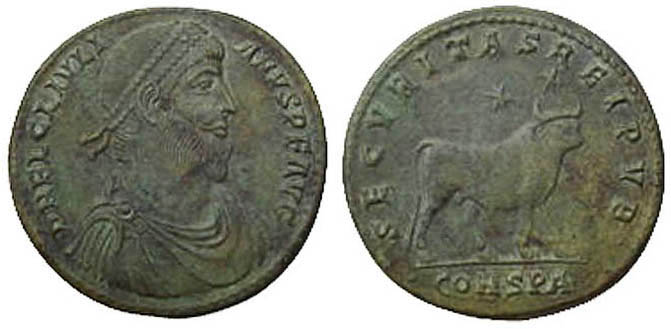
Julian II was the last Roman emperor to embrace paganism, though he failed in his three-year attempt as emperor to revive the worship of the old gods. The bull on his largest bronze coins was a proclamation of paganism. In Michael F. Hendy's 2008 book Studies in the Byzantine Monetary Economy C. 300-1450, he contended that these coins were the main element of Julian's efforts. Throughout history, in Rome as well in other culture, the bull has represented strength, masculinity, procreative power, and aggression. The bull on these coins is most commonly referred to as the Apis, a bull deity first worshipped in Egypt about two thousand years earlier. But it could also be Taurus, the sacred bull that survives in the constellation of the same name. What follows are one authentic official Julian II bull bronze coin issued c. 360-363 AD plus copies of this coin that span the ages. |
|
|||
|
|
|
|
|
|
|
|
|
|
||||
|
|
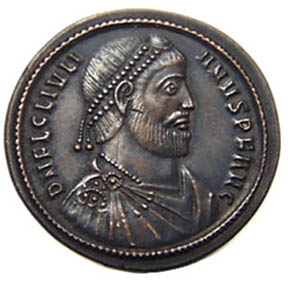
Julian II official ancient bronze coin (29mm, 7.5g), Nicomedia, Asia Minor (present-day Turkey), c. 360-363 AD, Sear 4072, RIC VIII 121, LRBC 2319. Obverse: Bust of Julian facing right. Reverse: Bull, a symbol of paganism, two stars (Gemini or Taurus), "SECVRITAS REIPVB" or "Security of the state." |
|
|||
|
|
|
|
|
|
|
|
|
|
||||
|
|
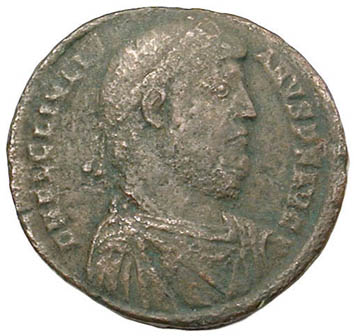
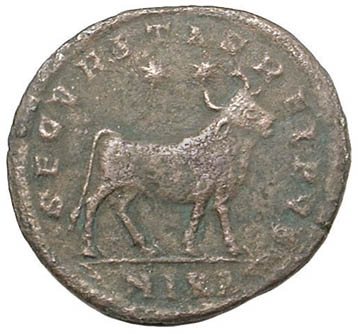
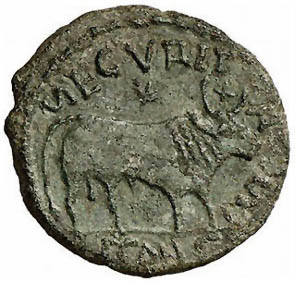
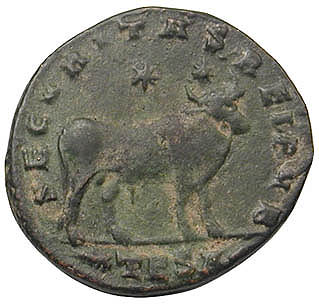
Julian II bronze ancient imitative (24mm, 8.2g). Most likely this was an ancient imitative issued by a tribal people such as the Gauls or the Franks, or it could have been an acient counterfeit issued within the Roman Empire. The eyes are overlarge, and the beard, mouth, diadem, bull, and inscriptions are rendered coarsely. The piece is in the correct weight range, but it's smaller and thicker than official Julian IIs. It's not clear what mint this imitative copies. |
|
|||
|
|
|
|
|
|
|
|
|
|
||||
|
|
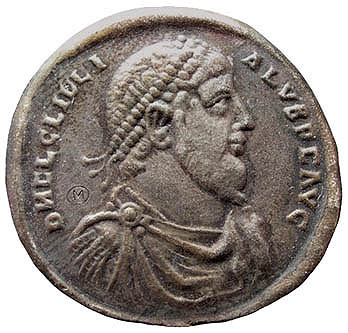
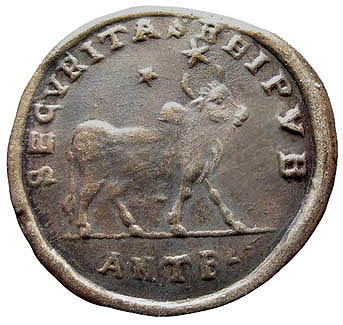
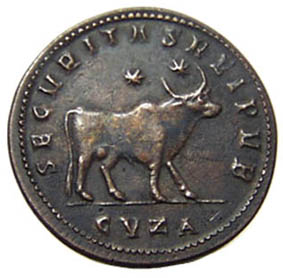
Julian II bronze old replica (28mm, 9.0g). This electrotype replica was issued in 1893 by Metallwaren-Fabrik Wilhelm Mayer of Stuttgart, Germany, a metal works company that along with coin replicas also produced medals, plaques, pins, and similar works. There's an M-within-a-circle countermark in the obverse left field. It copies a coin from Antioch (which in ancient times was a part of Syria but today is part of Turkey), RIC VIII Antioch 216. |
|
|||
|
|
|
|
|
|
|
|
|
|
||||
|
|
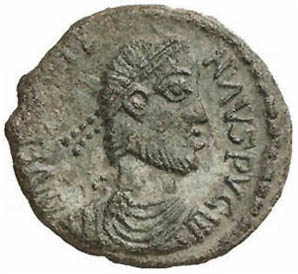
Julian II bronze modern forgery (26mm, 8.4g). This is a "Bulgarian School" forgery. It's a deceptive forgery, just a bit small, with convincing surfaces, edges, and patina. The styling is off only slightly, with Julian's face being too flat and his nose too shallow and the bull's head not facing heavenward. It was part of a small group of inexpensive coins that were all false. It copies a coin from Thessalonica, Greece, RIC VIII Thessalonica 225. |
|
|||
 |
|||||
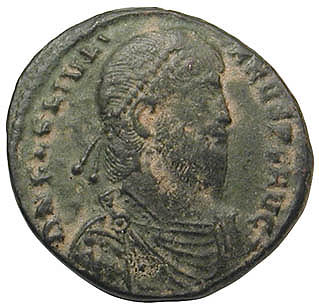
| Julian II bronze modern forgery (27mm, 8.9g). This is another "Bulgarian School" forgery. It was sold on eBay Australia by a seller in Bulgaria as an authentic coin, but he made the auction private, disclaimed knowledge of the coin's authenticity, and specified no returns. When questioned through email, he admitted it was a copy. The piece sold for only EUR 9,99, a fair price to be able to study and document the deception and help others avoid getting cheated. It appears pressed from original dies from one of Bulgaria's infamous forgery workshops, with the upturned mustache and overlong shoulder flap of the cuirass giving the piece away. It copies a coin from Constantinople, Asia Minor (present-day Turkey), RIC VIII Constantinople 162v. (no branch at end of mint mark). | |||||
 |
|||||
| Julian II bronze modern forgery (size and weight unknown). This forgery was put up for auction as an authentic coin by a major international auction house that sells many ancient coins but doesn't specialize in them. The size and weight weren't provided in the auction description, but the coin was attributed to to Antioch, RIC Vol. VIII, Pl. 28:216. Everything about the piece is uncongruous -- the hair, diadem, beard, drapery, bull, letterforms, and beading. When contacted, the auction house withdrew the piece. | |||||
|
|
|
||||
|
|
Julian II bronze Lipanoff forgery (23mm, 5.1g). Here's another "Bulgarian School" forgery, this one made by the Lipanoff Studio of Bulgaria. The piece is small and light, the edges are too regular, and the flan is too round. When rubbed with a baking soda paste, the patina came right off, revealing not a bronze interior but an interior made of some white metal alloy, perhaps pewter. It copies a coin from Cyzicus, Mysia, Asia Minor (present-day Turkey), RIC VIII Cyzicus 127. More on the Lipanoff Studio. |
|
|||
|
|
|
|
|
|
|
Other glomworthy coins:
Coin sites:
Coin Collecting: Consumer Protection
Guide
Glomming: Coin Connoisseurship
Bogos: Counterfeit Coins
Pre-coins
© 2013 Reid Goldsborough
Note: Any of the items illustrated on these pages that are in my possession are stored off site.