|
|
This coin type is the single most numerous of all ancient
Greek coins, with hundreds of millions struck at more than one hundred different cities on three continents during its
nearly three-century run.
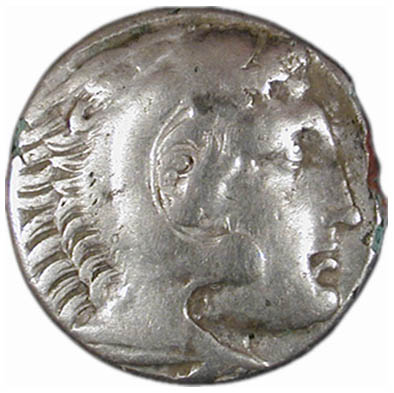
The obverse of virtually all of Alexander-type silver coinage, both coins like this one struck during Alexander
III's lifetime as well as the posthumous issues, features a portrait of Herakles/Hercules, the greatest mythological
hero of antiquity, wearing his trademark lion skin headdress, with the open mouth of the dead lion positioned so
as to appear to be biting the back of Herakles' skull. The lion skin refers to Herakles' killing the Nemean lion
in his First Labor.
The same or similar lion-skinned Herakles image appeared on the coinage of previous Macedonian kings, including
Philip II c. 359-336 BC (Sear Greek 6686), Perdikkas III c. 365-359 BC (Sear Greek 1514), Amyntas III c. 393-369
BC (Sear Greek 1510), and Archelaos I c. 413-399 BC (SNG Cop. 507). According to legend, this Macedonian royal
line, the Argead dynasty, was descended from Herakles.
The model for the first Macedonian Herakles coins was a tetradrachm from Kamarina, Sicily c. 450-420 BC (Sear Greek
758), according to Charles Seltman in his 1949 book Masterpieces
of Greek Coinage. These coins more clearly depict
the lion's jaws wrapped around the back of Herakles' head. Even earlier coins depicting Herakles include staters
from Dikaia, Thrace, c. 515-490 BC (Sear Greek 1345), and electrum hektes from Erythrai, Ionia, Asia Minor, c.
6th century BC (Boston MFA 1806, SNG von Aulock 1942).
Rulers after Alexander issued the same Herakles/Zeus type as Alexander but with their own inscriptions, including
Philip III, Seleukos I (and his successors Antiochos I, Antiochos II, and Seleukos II, who typically retained Seleukos'
inscription), Lysimachos, Antigonos II, the Paeonian dynast Audoleon, and the Thracian dynasts Kersibaulos and
Kavaros. Seleukos I issued one unusual issue in Alexander's name that's identical to a standard posthumous Alexander
tetradrachm except that it features Zeus holding Nike instead of an eagle.
Other rulers, regions, and peoples, before, during, and after Alexander's time, issued coins featuring a portrait
of Herakles on the obverse but with different reverses. Still other coins depict Herakles in other ways on coins
-- see Hercules
from Beast Coins for an introduction to this.
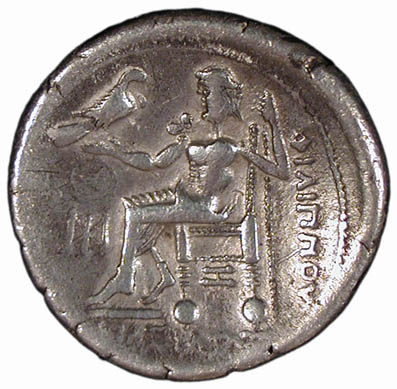
The reverse of Alexander's large silver imperial coins features Zeus seated on his throne holding an eagle, his
symbol, and a scepter, which refers to his status as king of the gods. The legend on these coins reads, in Greek,
"Of Alexander," as on this specimen, or "Of King Alexander." This specimen features a bucranium
(ox head) in the reverse left field, which is a mint control mark.
Alexander's Herakles silver coinage was minted as dekadrachms (rare), tetradrachms, diddrachms, drachms, 5th tetradrachms
(rare denomination used in Babylon), hemidrachms, diobols, obols, 30th tetradrachms (rare denomination used in
Babylon), hemiobols, and tetartemorions (quarter obols), with some of the hemiobols and quarter obols featuring
different reverses than the larger denominations. His bronze coinage, minted for local use, was more varied in
style, but the most common types also feature Herakles wearing a lion skin headdress on the obverse. Alexander's
gold coinage used a different design entirely, with Athena wearing a crested and plumed Corinthian helmet on the
obverse.
Alexander the Great was the single greatest conqueror of all time, never losing a battle between his ascension
to the Macedonian throne at age 20 to his premature death from malaria, bird flue, overmedication, poisoning, alcoholism,
or a combination of two or more of these causes at about the age of 33. He spread Greek culture from Egypt to India,
changing the world and leaving a legacy that included not only his massive coinage. Yet his attempt to unite East
and West proved ultimately a failure. The current onflict between the Islam dominated East and Judeo-Christain
dominated West, which has existed for more than a thousand years, is only the latest example of this disunity. |
|