|
|
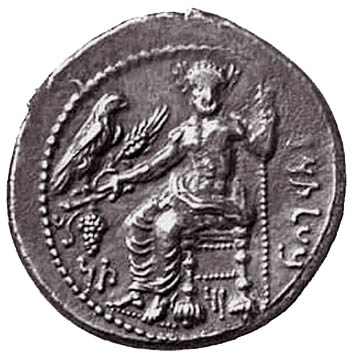
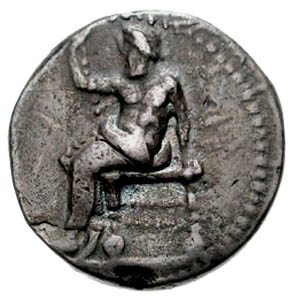
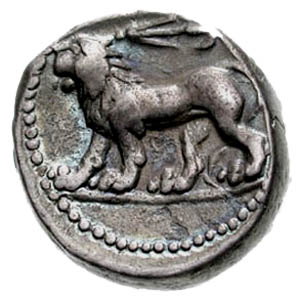
Mazaios stater (11.0g),
from Tarsos, Celicia, Asia Minor (present-day Turkey), c. 361-334 BC, Sear Greek 5650v. and BMC 21 52v. (same monogram
to left of Baal but no monogram under throne), SNG Levante 106v. (same mongram to left of Baal and under throne
but additional monogram under bull), SNG France 334-335v. (monogram to left of Baal is reversed), SNG Cop. -, SNG
von Aulock -, SNG Berry -, SNG Fitz. -, Boston MFA -, Traité -, BMC - |
|
|
|
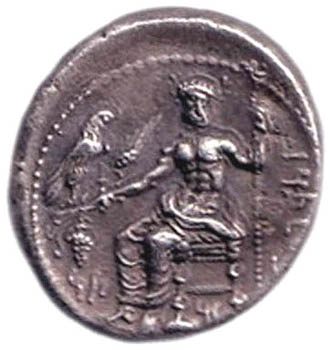
The obverse of this coin depicts the Baal (God) of Tarsos,
who's holding an eagle, wheat stalk, grapes, and a scepter. The obverse legend, in Aramaic, reads "Baal of
Tarsos." The name "Baal" is also spelled "Ba'al" and "Ba-al," and "Baal
of Tarsos" is also referred to as "Baaltars." Tarsos, a very old city thought to have been founded
at the end of the Neolithic Period c. 8000-5500 BC, was called Tarza by the Hittites, Tarzi by the Assyrians, and
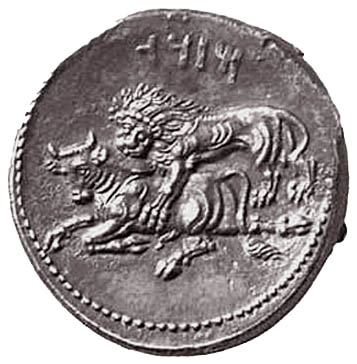
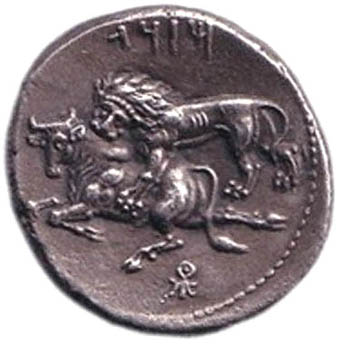
later Tarsus by the Romans. The reverse of this coin depicts a lion attacking a bull and the Aramaic legend for
"Mazaios."
This coin features a lion-and-bull motif as did earlier Anatolian coins of Kroisos/Croesus. But here, on the reverse,
the full bodies of both lion and bull are shown, and the lion is ferociously jumping on the back of the bull, who's
kneeling. If you assume that a kneeling bull (without a lion) on the scores of later Greek and Roman coins is symbolic
of Zeus, a position that Marvin Tameanko has persuasively argued for (Celator, Jan. 1995, pp. 6-11), and that the
lion is symbolic of the supreme god, or Baal, of the Celicians, the symbolism of this coin, as with previous lion
and bull coins of Kroisos, may be direct and simple: Our god is more powerful than your god. This was a reality
that would have been questioned beginning with Alexander the Great's victory at the Battle of Issos near Tarsos
c. 333 BC.
An earlier fifth century BC coin of Tarsos (SNG Levante 54) depicts a similar scene of a lion attacking a bull,
but on the obverse instead of the reverse, with the reverse depicting an ear of wheat (often referred to as "corn").
Other coins that similarly depict a lion attacking a kneeling bull include fifth century BC tetradrachms from Akanthos,
Macedon (Sear Greek 1270-1272), and fourth century BC silver coins of Byblos, Phoenicia (Sear Greek 6008-6014),
and the symbolism on these may carry a similar meaning, or it may not. But third century AD Roman Provincial bronzes
from Viminacium, Moesia Inferior, with a reverse of the emperor or Victory standing between a facing lion and bull,
must necessarily carry a different meaning. Third century AD Roman Provincial bronze medallions of Gordion III
from Tarsos, on the other hand, harken back to these much earlier coins from Tarsos.
The first coins depicting a seated Baal were minted by the Persian military commander Pharnabazos c. 380 BC (Sear
Greek 5641). The Baal obverse of Mazaios' coinage may have been used as the model for the Zeus reverse of Alexander
the Great's huge output of silver coinage, though Martin Price believed that both coinages were based on similar
models. Price did feel, however, that the celator who engraved the latter Mazaios staters also engraved Alexander
III's Tarsos tetradrachms. What is clear is that the same basic coin icongraphy that began with Baal, of seated
deity/personification holding symbols in each hand, would be borried and borried again, up to the present day.
Mazaios also issued Baal silver fractions with different reverses, including an eagle and a wolf.
"Baal" is a Semitic word for "Lord" or "God." Monotheistic ancient Hebrews regarded
Baals other than Yahweh as false idols. Along with Yahweh, other Baals that Old Testament Hebrews worhipped included
Horus, Nehushtan, Etana, and El. Some kings in Asyria and Philistine used the word "Baal" as part of
their title. Later, the word "Baal" became a Christian name for a devil.
Mazaios (also referred to as "Mazaeus" and "Mazday") was the Persian satrap of Celicia beginning
c. 361 BC, then the satrap of both Celicia and the larger territory of Transeuphratesia/Transeuphrates (Syria and
Palestine, also known as Abar Nahara) beginning c. 345 BC. Mazaios fought Alexander the Great at the Battle of
Gaugamela in 331 BC (it's likely that he was withdrawn as satrap of Celicia, but not Transeuphratesia, shortly
before this time). After this loss, he fled to Babylon. With the Great King Darius III of Persia also fleeing Alexander's
army, Mazaios was the person who surrendered the capital of the Persian Empire, Babylon, to Alexander later in
331 BC, which prevented the sack of the city. For doing this without a fight, Alexander appointed him governor
of Babylon, which at the time was the world's largest city. Mazaios died in 328 BC.
Monograms on these Mazaios coins can be present in front of Baal's legs, under his throne, and under the bull on
the reverse. The monograms as they appear on this specimen don't appear on Mazaios stater specimens in any of the
references I've checked so far, making this variety possibly unlisted, though it's similar to some that are listed.
With some varieties of these coins (SNG Cop. 308, for intance), Baal's torso is facing left rather than forward
as on this specimen. A barbarized version (SNG France 353) depicts a crude rendering of Baal's head and torso.
An earlier type of Mazaios depicts a lion attacking a stag instead of a bull (Sear Greek 5649, SNG Cop. 306-307).
A later type of Mazaios depicts a row of battlements (protective or decorative structures on top of a wall) below
the bull (Sear Greek 5651). A similar type, with lion attacking bull, was issued by Balakros, the satrap of Cilicia
under Alexander the Great (Sear Greek 5654-5655). |
|
|
|
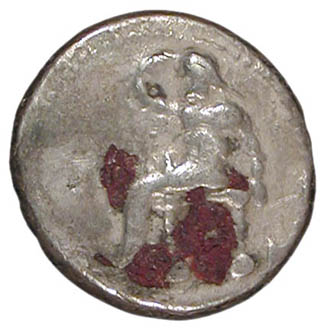
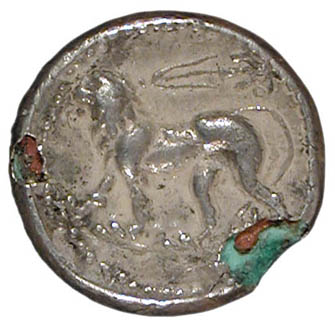
This is one of the thousands of cast fakes sold as authentic coins on eBay over an astounding period of about four years in the early 2000s by a scammer operating out of Toronto, Canada. The forger is sometimes called the Toronto Group, but there's no indication that there was anyone behind this other than a single individual making poor- and medium-quality cast copies in his basement, and the Toronto Forger is a more fitting name.
The Toronto Forger put up on eBay several dozen cast fakes at a time with each round of his scam auctions, typically the same fakes each time, with new fakes added as he went along, using the same photos, with new photos used as he went along. He created more than 40 rounds of scam auctions, using a different eBay I.D. each time. Despite many people contacting eBay, it had no mechanism in place to act in a timely way, and to this day it still doesn't read or act upon most messages sent to it. With every round of scam auctions, eBay canceled this forger's I.D. (NARUed him, for Not a Registered User), but until near the end of this forger's run it generally wasn't until after the auctions were over and most people had likely already paid and received their items. eBay sent messages to the people who had been scammed, but its intent was only to try to absolve itself of responsibility. The message contained the following language: "eBay is only a venue, and we cannot guarantee that sellers will complete transactions nor can we guarantee the delivery or quality of bought items."
Estimating conservatively, the Toronto Forger scammed 1,000 people out of $150,000. This scammer seems to have ceased operations, but a number of other crooks have come along and emulated his tactics. eBay has gotten better at stopping the most blatant forgery scammers, but it appears to be a sporadic effort. Other scammers have made businesses of selling fakes of ancient coins and artifacts as authentic on eBay, operating for years, despite the best efforts of people, as well as the American Numismatic Association, to prevail upon eBay stop them. One lesson is that you should never bid on anything on eBay that can be faked unless you're expert in the area, know the seller, or have gotten a recommendation about the seller from a reliable source. Don't expect eBay to protect you. It typically doesn't even read the messages it receives from people telling it that a seller is breaking eBay's own rules, such as disclaiming knowledge of authenticity. Instead, it just sends back an automated response indicating receipt of the message, with no action taken.
Here's a catalog of these Toronto
forgeries. |
|
|
|
The obverse of this coin depicts the Baal (God) of Tarsos,
who's holding a scepter. The reverse depicts a walking lion lion walking and a Seleukid anchor (Seleukos I's symbol).
This particular specimen is impressively thick -- 6mm thick -- and has a flat edge that's perpendicular to the
obverse and reverse.
This coin is an example of the second major type of Baal/lion coin, with a walking lion on the reverse. This coin
type was first minted by Mazaios as a stater ("lion stater") in Tarsos (Sear Greek 5652), though some
numismatists have attributed these to Myriandros or Issos, and then as a larger tetradrachm ("lion tetradrachm")
in Babylon (Sear Greek 6139-6142). This type was continued by several rulers after Mazaios, including Mazakes and
Seleukos I. The above coin was issued by the latter, as is evidenced by the Seleukid anchor on the reverse. Seleukos
also issued these with various mint-control marks to the left of Baal under the lion and a pentalpha (five-pointed
star) instead of an anchor. He also struck silver fractions of this type.
This coin was one of several tetradrachm types issued by Seleukos I, Alexander the Great's successor in Persia
and the founder of the Seleukid dynasty. He also issued Alexander-type coins, coins depicting what's likely a portrait
of Alexander the Great in a panther skin helmet, several types with an elephant or elephants on the reverse, and
types depicting a horse or horse's head.
The Seleukid dynasty ruled over Syria, Asia Minor, Palestine, Persia, and Babylonia before losing the eastern provinces
of Baktria and Parthia, then Pergamon, then Judea to the Maccabees, and finally as a small fraction of its former
size being absorbed by Rome in 64 BC. The Roman Empire in the East, the Byzantine Empire, would in turn experience
a similar fate, gradually losing territory before it was finally absorbed by the Ottoman Turks in 1453. |
|