|
|
The attribution of ancient coins is frequently debated,
with new hoard evidence, new interpretations of that evidence, new die studies, and new historical interpretations
typically providing the fodder. The two coins above are a case in point.
In the late 1970s T.V. Buttrey analyzed a hoard of 347 Owls excavated from the Fayum, Egypt, in 1934/1935 (the
as yet still unpublished Fayum/Karanis hoard), spelling out his conclusions in his 1979 article titled "Pharaonic
Imitations of Athenian Tetradrachms" from the Proceedings of the 9th International Congress of Numismatics
and his 1984 abstract of this article titled "Seldom What They Seem -- The Case of the Athenian Tetradrachm"
in Ancient Coins of the Graeco-Roman World: The Nickle
Numismatic Papers.
His main conclusion bordered on the revolutionary: "Many, and perhaps most, of the coins always taken to be
the abundant late-fifth-century Athenian tetradrachms may, in fact, be fourth-century Egyptian imitations."
Buttrey is one of the numismatic world's most esteemed scholars, but this far-reaching conclusion hasn't been accepted
by the numismatic establishment.
Buttrey supported his conclusion with photos of only three coins. Christophe Flament and Peter van Alfen provided
additional photos of these same varieties, Flament in his Revue Belge de Numismatique 147 (2001) article "A
propos des styles d'imitations Athéniennes définis par T.V. Buttrey," and van Alfen in his American
Journal of Numismatics 14 (2002) article "The 'Owls' from the 1989 Syria Hoard, with a Review of Pre-Macedonian
Coinage in Egypt." Their photos, however, didn't support a conclusion as ambitious as Buttrey's.
Buttrey feels that both of the above Owls are Egyptian in origin. The bottom coin does make a strong case for being
an imitative Egyptian Owl. It features on the obverse a frontal eye, like 5th century Athenian Owls, but the owl
on the reverse has coarser feathers, like 4th century Athenian profile-eye Owls. Athena's lips and the shape of
her face are also very un-Athenian. This specimen is a near perfect likeness to the specimens van Alfen illustrates
as Buttrey/Flament Style X Egyptian imitative Owls, and in particular the first specimen illustrated.
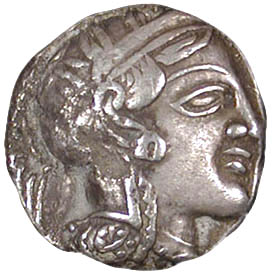
The top coin on this page, however, is of fine style, without any barbarized features. It has a similar fabric
as the Egyptian Owl, particularly the narrow lip around the edge on the reverse. But stylistically it falls squarely
within the realm of official Athenian issues.
A recent metrological study by Christophe Flament and Patrick Marchetti, reported in their paper "Analysis
of Ancient Silver Coins" and published by Nuclear Instruments and Methods in Physics Reaearch B 226 (2004),
supports the Athenian origin of many of the questioned pieces, or at least the Athenian origin of the silver used in them, including the coin pictured at the top of this page.
Using a nondestructive technique called PIXE (proton induced x-ray emission), they analyzed 18 Owls whose characteristics
fall within the realm of coins described as Egyptian imitations of Buttrey Style B or Buttrey Style M.
Their purpose was to determine the amounts of trace elements in the coins. Native Athenian Owls minted using silver
from the Laurion mines outside Athens have a lower content of both gold and copper and a higher content of lead
compared with other ancient Greek silver coins minted using silver mined elsewhere. They discovered that the so-called
Egyptian Owls had the same gold and lead levels as native Athenian Owls. They therefore concluded, based on this
analysis as well as their reading of other sources, that most Owls that are of the same weight and metal quality
as official issues, that don't have non-Greek or barbarized legends or other marks, and that exhibit style differences only
involving subtle or careless changes are probably official Athenian issues.
You could argue that the coins that Buttrey questioned were minted in Egypt using Laurion silver, and in an online post Buttrey has argued just that. He also indicated he found stylistic
links between some of the Owls he believes are Egyptian and some of those with an Aramaic legend that are definitely Egyptian.
But the economics also supports the Athenian rather than the Egyptian origin of the vast majority of these coins.
The Egyptians were large exporters, particularly of grain, to Athens and the rest of Greece. They received coin
in exchange, Athenian Owls in large numbers and other Greek coins too, which they treated as bullion, as the widespread practice of countermarking supports. Some of these
coins ended up in hoards there. Egypt had no need to mint large numbers of coins during this period. Athens, on
the other hand, needed a large output of coinage to finance its great building projects as well as the Peloponnesian
War.
Even if Buttrey did reach too far with his conclusions, what his work does accomplish is refute the longstanding
notion that prior to Alexander the Great's conquest of Egypt virtually no coins were struck there. David Sear spelled
out this view in his 1979 Greek Coins and Their Values,
Volume II: "The ancient civilization of the
land of the Pharaohs felt little need of coinage before the time of Alexander the Great." Similarly Colin
Kraay spelled it out in his 1976 book Archaic and
Classical Greek Coins: "Egypt generated little
coinage of its own before Alexander's conquest."
It appears that Egypt did in fact strike many coins, coins in imitation of the ubiquitous Owls of Athens, the world's
first widely used international coinage, though in much smaller quantities than Athens did. Egypt didn't have native
silver mines but after being exposed to coinage, did develop a need for it. It's likely that most coins attributed as late-fifth-century Athenian tetradrachms are in fact late-fifth-century Athenian tetradrachms, but some fairly sizable quantity are Egyptian.
These Egyptian Owls were Egypt's first coinage. Some have argued that Egypt first began minting imitative Owls, sometimes called pseudo-Athenian Owls, because of the scarcity of Athenian Owls caused by Sparta shutting down Athen's Laurion silver mines near the end of the Peloponnesian
War. It's likely, however, that Athens continued minting Owls during this time, if in much smaller numbers, melting and reminting foreign silver coins and earning profits from this. Nonetheless, this likely provided the impetus for Egypt to do the same or perhaps to ramp up what it had started earlier. As did other peoples, perhaps Egypt began minting Athenian-style Owls as their first coinage, copying Athens and hoping to profit in the same way. Then, feeling the scarcity of Athenian Owls after c. 413 BC, Egypt significantly increased its own coinage production, using other silver coins as raw material.
Egyptian Owls were initated near the end of the great Pharaonic Age in Egypt that began c. 3100 BC. Egypt's golden age,
the height of her power, occurred during the New Kingdom, from the Eighteenth to the Twentieth Dynasties, c. 1567-1085
BC. Though this was long past the age of the great pyramids, Egypt's power and influence were greatest during this
time. Amenophis IV/Akhnaton may have established the world's first organized monotheistic religion during the 14th
century BC, and passed his beliefs on to Moses. Later, during the first half of the first millennium BC, the Libyans,
Nubians, and Assyrians ruled Egypt for periods of time, which was followed by Persia's domination c. 525-404 BC.
Egypt regained her independence after c. 404 BC and held it until reconquered by Persia c. 343 BC.
After this, Egypt would remain under foreign domination until 1952.
Other countries or regions that initiated its coinage in whole or part with Athenian Owl imitations include South and North Arabia, Philistia, Judea and Samaria, Syria, Babylonia, and Bakria. After minting
imitative Owls that copied Athens' AQE ethnic, meaning "Of the Athenians,"
Egypt under Persian rule between c. 343 and 332 BC continued minting imitative Owls but the ethnic
was now in Aramaic, not Greek, and read "Of Pharaoh Artaxerxes," "Of Sabakes," or
"Of Mazakes." Artaxerxes III was the king of Persia c. 358-338 BC, while Sabakes and Mazakes were the Persian
satraps of Egypt before the arrival of Alexander c. 332 BC. Owl coinage in Egypt came to an end with Alexander.
I bought the Egyptian Owl illustrated above as an attractively priced unattributed "Eastern" Owl at the
2002 ANA World's Fair of Money. It took reading through a couple of dozen journal articles and published collections
before nailing down the attribution with van Alfen's article. Because it lacks non-Athenian letters or marks, it can safely be dated before c. 343 BC, and it was probably minted after c. 413 BC.
I bought the Athenian Owl illustrated above through eBay in 2001, also attractively priced, but in its case undoubtedly
because of the ugly yellow-green toning it was covered with (here's what it looked like before the cleaning). With
this coin, the opened inner corner of Athena's frontal eye indicates that it's beginning to transition into a profile
eye and that the coin is thus likely a late fifth-century specimen, issued c. 431-413 BC to finance the Peloponnesian
War.
Gleaning information about a coin from its style alone is far from foolproof. What's needed is a die study linking
large numbers of the ATHE Owls to later Owls with Aramaic legends that are demonstrably Egyptian. Unless this happens,
the top coin pictured above and thousands of similar ones will no doubt continue to be attributed as official Athenian
Owls by dealers and auction houses, despite the fact that some references, such as SNG München, now admit
the possibility that some of these coins may be Egyptian.
Here are some other imitative
Owls, part of my main site on Athenian Owls. Other
pages of mine on coins copying Athens, Alexander the Great, Lysimachos, Parion, Thasos, Constantine the Great,
and other coins can be found at my site on Ancient Imitative Coinage. |
|