|
|
|
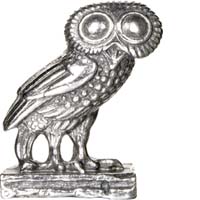
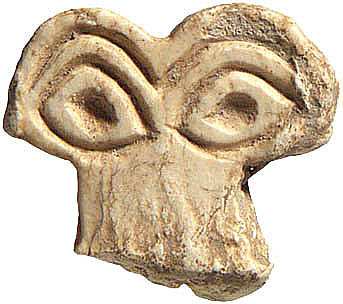
High-relief coins are almost three dimensional in their sculptural quality. But they only approximate statues, figurines, and similar objects. The three objects below pay tribute or share a connection to the owl depicted on ancient Athenian Owls. |
|
|
|||||
|
|
|
|
|
|
|
|
|
|
|
|
|
|||||||||
|
|
|
British Museum owl figurine (37 mm x 27 mm). This small pewter owl figurine closely, and beautifully, copies the owl on the Classical Owl. It's a product of the British Museum's online gift shop, and I bought it there in 2008. The British Museum has a huge collection of ancient Greek and Roman coins and artifacts among its seven million items from all continents, which document all of human history. Greece being the foundation of Western civilization, it's only fitting that Greek antiquities are heavily represented. All those living in the West share in this heritage. Yet Greece, Italy, Turkey, and other countries that are the source of many ancient coins and artifacts are engaged in a campaign to "repatriate" items that they feel should reside only in their country, an issue variously referred to as "art repatriation" and the "restitutionist premise." Perhaps the most well-known example is the Elgin Marbles, also known as the Parthenon Marbles, which are a group of marble sculptures, inscriptions, and architectural members that originally were part of the Parthenon and other buildings on the Acropolis of ancient Athens and that have resided in the British Museum since 1816. Interestingly, while trying to get ancient Greek antiquities returned, modern Greece boasts about its own museum's collection of the antiquities of ancient Egypt and other countries. No doubt other source countries do the same. |
|
|
|||||
|
|
|
|
|
|
|
|
|
|
|
|
|
|||||||||
|
|
|
Modern Greek owl figurine (10.6 cm x 6.7 cm). This large plaster owl figurine loosely copies the owl on the Classical Owl. I bought it in Athens in 1974 in the old marketplace called the Plaka, which is the oldest section of modern Athens at the base of the Acropolis. The Plaka was built around 1830 shortly after Greece regained independence from Turkey. This owl figurine is the first I acquired. The plaster this figurine is made of is sometimes called Plaster of Paris and chemically is calcium sulfate hemihydrate. In addition to its use in the sculptural arts, plaster is also used as a building material. It's made from gypsum, a soft calcium-based mineral. This figurine pays tribute to the Classical (and Archaic) Owl by copying the owl's posture and styling, but the lines radiating out from the eyes appear to be meant as eyelashes rather than as head feathers. It's a slightly abstract and not unattractive modern rendering of the ancient design. |
|
|
|||||
|
|
|
|
|
|
|
|
|
|
|
|
|
|||||||||
|
|
|
Ancient Mesopotamian eye figurine head (25mm tall, 27mm wide, 5-8mm thick, 5.75g). This doesn't represent an Owl, but it shares a connection. It's a piece of ancient art, primitively yet evocatively designed, from the origins of civilization, ancient Mesopotamia, made c. 3200 BC. At over 5,000 years old, this eye figurine head is older than the Pyramids of Giza. The first civilizations are widely believed to have begun in Mesopotamia and Egypt between 3500 and 3000 BC. This piece was found in northern Mesopotamia along with thousands of similar pieces excavated at an ancient Mesopotamian temple now called the Eye Temple because of this and other ancient artwork found there. These eye figurines were incorporated into the mortar with which the mudbrick temple was built. The temple remains are located near Tell Brak, also known as Tal Brak, Tall Birak, or Brak/Nagar, in present-day northeastern Syria. A tell is a mound formed over a long period from the remains of previous settlements. Tell Brak was one of the first large cities in Mesopotamia, developing contemporaneously with better known cities of southern Mesopotamia such as Ur and Uruk. Tell Brak was first officially excavated by British archeologist Max Mallowan, husband of novelist Agatha Christie, in 1937-38. These ancient eye figurines could be bought openly at various markets in Syria and Iraq into the middle of last century. Evidence of modern forgery includes modern tool marks seen under magnification and elaborate individualizing characteristics such as hair. I bought the above piece through a Harlan J. Berk auction from an antiquities collector and consultant, who had bought it through a Leslie Hindman Auctioneers estate auction in the early 1990s. The most credible theory of the purpose of these eye figurines is that they were used as votive offerings, or gifts, to a god or gods, representing the people who offered them (which makes the name often used for them, "eye idol," a misnomer). A competing theory, proposed by Mallowan, is that they represented the Sumerian fertility goddess Inanna (and thus were idols). Inanna was later identified with the Semitic goddesses Ishtar and Astarte, the Egyptian Isis, the Greek Aphrodite, the Etruscan Turan, and the Roman Venus. Perhaps the same general image served the purposes of both votive and idol, with worshippers fashioning figurines of themselves patterned after their eye goddess, offering themselves to her, and fashioning a larger statue with similar eyes, now lost, before which they worshipped. It's also unclear exactly what the eyes signify. Wide-eyed figures are common on other early Mesopotamian art, and artwork with disproportionately large eyes is found in many other ancient cultures as well, from prehistoric Britain to India. Thus this particular icongraphy must necessarily have served a primordial yearning. The meaning of the eyes likely falls into one, or perhaps more than one, of three areas: wisdom, pretection, and sexuality. Wide eyes are all-seeing, and thus all-knowing. It's here that there's a connection to the Owls of Athens, with the wide eyes of both Athena, goddess of wisdom, and her owl seeing all, knowing all. Wide eyes are also attentive, watching over and protecting. And wide eyes can signify sexual attraction and excitement. Eyes have served similar purposes throughout the millennia. The Eye of Providence, enclosed in a triangle and surrounded by light rays, was incorporated into the Great Seal of the United States when it was adopted in 1782, and even more visibly it has appeared on the U.S. $1 bill since 1935. The Eye of Providence is an all-seeing eye that's sometimes interpreted as symbolizing the eye of God keeping watch over humanity. Like the modern owl figurine pictured on this page, the ancient eye figurine head pictured above is made of gypsum, a soft calcium-based mineral. Other similar eye figurines found at Tell Brak were made of alabaster (another type of gypsum), limestone, marble (rock formed by alteration of limestone or dolomite), steatite (soapstone), and bone. Tell Brak eye figurines are flat, plank-type artifacts, with iconography on only one side. Other Mesopotamian eye figurines are round and three-dimensional, with the eyes portrayed as an open cylinder, though Tell Brak types are the most common. Most Tell Brak eye figurines consist of one figure, some consist of two conjoined figures, likely signifying a husband and wife, others depict a larger figure embracing a smaller one, likely signifying a mother and child, and a few are adorned with a conical hat, likely signifying a priest. Most were found broken, often as with the piece pictured above with the head having broken off from the body. Sometimes heads are reattached to bodies, though any given head may not be reattached to the body it was originally attached to. With all Tell Brak eye figurines, the body like most of the face is featureless, the emphasis being strictly on the eyes -- two pupils, two orbits, and one unibrow. |
|
|
|||||
|
|
|
|
|
|
|
|
|
|
|

Other glomworthy coins:
Coin sites:
Coin Collecting: Consumer Protection
Guide
Glomming: Coin Connoisseurship
Bogos: Counterfeit Coins
Pre-coins
© 2013 Reid Goldsborough
Note: Any of the items illustrated on these pages that are in my possession are stored off site.