|
|
|
Coins have been counterfeited since the invention of coinage.
Before coinage, pre-coin precious metal ingots were counterfeited as well. In ancient times, forgers typically
counterfeited coins by plating a base metal core with a precious metal exterior, since the value of coins was tied
to the value of their metallic content. Such coins are called fourrees. |
|
|
|||||
|
|
|
|
|
|
|
|
|
|
|
|
|
|
||||||||
|
|
|
Emergency Issue Fourree Classical Owl tetradrachm (12.8g), c. 406-404 BC, Sear 2535, Svoronos Pl. 15 No. 13. Unlike the other fourrees illustrated on this page, the above specimen was in all likelihood officially issued by Athens as circulating currency. This and similar coins were issued during the final stages of the Peloponnesian War (c. 431-404 BC), which Athens lost to Sparta. These coins were a desperate attempt by Athens to stretch its now extremely limited resources. The style reveals it's likely an official emergency issue rather than an unofficial plated counterfeit, with the inner corner of Athena's eye beginning to open up, as happened with the Emergency Issue gold coinage issued about a year earlier, anticipating the fully opened profile eye of Intermediate Style Owls. Not everyone agrees, however, that these coins are official. In an October 2005 Celator article, Michael Marotta argued for the following conclusion: "Only those silver-plated owls with provenance to the Eleusis Hoard of 1902 have any hope of being Emergency Owls," which was followed by "All others are simply worthless fakes." Such a conclusion was unpersuasively supported. The Eleusis Hoard like all hoards in all likelihood represents only a very small percentage of any given type of coin in use in ancient times. It's illogical to presume or imply that all coins of this type wound up in this one hoard. The author also didn't make it clear what he means by worthless. Even private forgeries, such as the coins illustrated below, can have considerable worth for collectors today, bringing sometimes high prices in auction and other sales. In ancient times, private forgeries may have been officially worthless, but they weren't to those who were passing them off as official coins. Regarding the official nature of the so-called Emergency Issue Owls, the author dismissed the literary evidence, from Aristophanes at the end of the fifth and beginning of the fourth centuries BC, without offering an explanation for this evidence, for why Aristophanes wrote what he wrote. It's not typical for a coin attribution to be supported by contemporaneous written evidence like this. Aristophanes talked about "coppers," derogatively. The author implied that he would have called them silver-plated copper coins if that's what they were. But what else could they have been if they weren't silver-plated copper coins? Athens at the time didn't issue any official copper/bronze coins, at least not in any quantity, but there are two other possibilities that Aristophanes' could have been referring to besides the Emergency Issue fourrees. First, Aristophanes could have meant the small bronze coins/tokens called kollyboi, which appeared in Athens c. 400 BC. But they were likely issued in small numbers given their survival rate today, and they were likely issued privately, since they bear no ethnic or other identifying mark of Athens. Most important, if Aristophanes had meant to refer to kollyboi in his plays Frogs and The Women's Council (The Assemblywomen), he would have done so using the words kollyboi or kollybos, as he did in his play Peace. Second, Aristophanes could have meant the tiny bronze obols and diobols that were likely minted officially in Athens at about the same time. But these are extremely rare coins today and were likely were issued in very small numbers and only for a brief period of time. In his play Frogs Aristophanes was likely referring to neither. E.S.G. Robinson, in his 1960 ANS Museum Notes article, "Some Problems in the Later Fifth Century Coinage of Athens," which includes a detailed and excellent discussion of these Emergency Issue coins, points out that Aristophanes' inclusion of the term "redhead" was commentary on the official silver-plated copper tetradrachm and drachm emergency coinage. The thin silver plating wore away quickly in circulation, exposing the underlying copper/bronze at the highpoint on Athena's head above her temple. Alan Walker made the same point in his 1982 article "Some Plated Coins from the Agora at Athens," in the Proceedings of the 9th International Congress of Numismatics. What Aristophanes couldn't have been referring to was plentiful circulating all-bronze coinage. Unlike other city-states Athens resisted for some time the move away from tiny silver fractions used for small marketplace transactions to larger bronzes used for the same purpose. Though bronze coinage was initiated in Sicily in the mid-fifth century BC, it didn't become popular in Athens until the first half of the fourth century BC. Aristophanes' term "coppers" in Frogs was in all likelihood a nickname, a derogative shortened name for silver-plated copper/bronze tetradrachms and drachms, with only the tetradrachms issued in large number and surviving in large number today. The Celator article mentioned that no Emergency Issue Owls have turned up so far in the Athenian agora. But the author didn't mention that very few tetradrachm- and drachm-size coins in general have turned up there either, a reality that John Kroll reported in his 1993 book The Athenian Agora, Vol. XXVI: The Greek Coins, which the author referenced. The agora, or marketplace, was where small marketplace transactions took place and where small fractional coins (and later, bronzes) were typically used, not the larger coins of state transactions and international trade. Kroll, who led the Athenian agora excavations, himself believes that these particular fourrees are official coins, not private forgeries. The author of the Celator article also wondered why these silver-plated pieces if official weren't marked in some way to show they weren't solid silver. Kroll earlier pointed out one possible answer to this question in his 1972 book Athenian Bronze Allotment Plates. Their being 15 to 25 percent underweight would have indicated their nature compared to the large, heavy pure silver coins that preceded them. This argues for these coins being fiduciary, much as all-bronze coins elsewhere in the Greek world were fiduciary. Perhaps this was the Athenians' first large-scale experimentation with fiduciary coinage, with it backing these coins with promises of future payments in silver, asking its citizens, and perhaps its allies as well, to help out during this time of crisis. Alan Walker is another numismatist who worked at the Athenian agora and who also believes these are official coins, like virtually every numismatist who has written about this. In the 1982 article of his previously cited, he suggested that the Emergency Issue coinage was used for local trade, freeing up scarce silver for external trade during this time of grave danger to Athens. But it's not clear to me that these were in fact fiduciary coins, made without intention to deceive, or official counterfeits. Another reasonable scenario is that the Athenians, in desperation, were trying to pass this coinage off at the same value of previous coinage without the knowledge of those using the coinage in the similar manner that private forgers in ancient times tried to pass off underweight silver-plated copper coinage to the unsuspecting. The Athenians were desperately trying to stretch their near depleted resources to fend off the Spartans, using these pieces to buy supplies and replace equipment and pay soldiers and mercenaries in order to save their city. They weren't thinking about the future trustworthiness of Athenian money. They were trying to prevent their city from being leveled and themselves from being killed. There are many other instances throughout history of the use emergency money, also known as siege pieces, provisional money, and necessity money. |
|
|
|||||
|
|
|
|
|
|
|
|
|
|
|
|
|
|
||||||||
|
|
|
Ancient counterfeit fourree Classical Owl tetradrachm (13.0g), c. 5th century BC. Many silver-plated Classical Owls are called Emergency Issues, with some dealers trying to sell up their coins in this way. The majority of plated Owls in all probability are simply ancient counterfeits, and not as desirable, rather than official coins issued in desperation by one of history's greatest cities and having appeal for this reason. How experts distinguish unofficial ancient counterfeit Owls and official Emergency Issue Owls, right now, is through stylistic analysis. Die analysis would be a more accurate method, but as yet no one has attempted this. Still, stylistic analysis is on fairly firm ground here. The style of Mass Classical Owls evolved during the more than half century in which they were issued, though the stylistic variation wasn't nearly as great as the jump from those Owls that preceded them as well as those Owls that followed them. Svoronos in his Corpus of the Ancient Coins of Athens does a good job of illustrating Emergency Issue Owls and placing them within the context of other late Mass Owls. The style of the above coin indicates it's not an official Emergency Issue silver-plated copper Owl but an unofficial counterfeit. Athena's eye is symmetrical and closed at the right corner in the style of early Mass Owls, not asymmetrical and open in the style of late Mass Owls that the Emergency Issues were part of. Also, Athena's nose is overlarge and totally un-Athenian, styled much like the noses on many tribal or "barbarous" ancient coins that copied classical designs. Unlike with many Owl fourrees, this one hasn't been test cut, which was a commonly used method in ancient times to uncover silver-plated coins of this and other types by taking a chisel or other blade to the surfaces to reveal the interior. In this case the interior has been revealed only over the course of many centuries of the coin being buried underground, with corrosion eroding the silver plating in parts. The brown is the underlying copper. The green is the intermediate area separating the copper interior from the silver plating, sometimes called the eutectic layer. Metallurgical analyses of other fourrees indicates that this layer consists of 72 percent silver and 28 percent bronze. It's unclear whether the eutectic layer was a copper-silver solder applied to help bond the silver plating to the copper core or was formed when the silver-plated planchet was heated, partially melting and interdiffusing the silver and copper. Not all fourrees display silver, brown, and green areas, though among people who collect fourrees those that do are deemed more attractive and desirable. Some fourrees reveal only a brown interior. Some have plating that's entirely intact and are revealed for what they are through their low weight and sometimes as well by stylistic anomalies. And some have plating that's entirely corroded away. |
|
|
|||||
 |
 |
||||||||
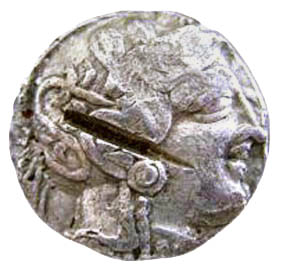
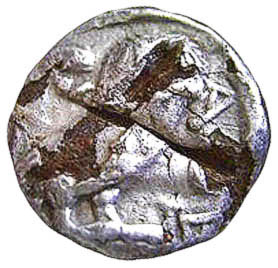
Ancient counterfeit test-cut fourree Classical Owl tetradrachm (14.2g), c. 5th century BC, SNG München 58. The obverse and reverse test cuts reveal that this coin is a silver-plated bronze, with its light weight being another diagnostic. Because of the test cuts and the styling, with the upper and lower parts of Athena's eye being proportional, this is likely an ancient counterfeit rather than an Emergency Issue Owl. It was said to have been found in Gaza. |
|||||||||
|
|
|
|
|
|
|
|
|
|
|
|
|
|
||||||||
|
|
|
Ancient counterfeit stripped fourree Classical Owl tetradrachm (9.2g), c. 5th century BC. This silver-plated bronze dramatically demonstrates what time can do to a coin. The silver plating has nearly completely
worn and corroded off, revealing almost all of the bronze core. The coin was also test cut in ancient times.
|
|
|
|||||
|
|
|
|
|
|
|
|
|
|
|
|
|
|
||||||||
|
|
|
Ancient counterfeit fourree Classical Owl tetradrachm (13.7g), c. 5th century BC. Here's a very interesting and somewhat mysterious specimen. It's lightweight, at 13.7 grams, and has a small spot of copper visible at the back of Athena's neck near the coin's edge (not visible in this photo). Yet the test cut, actually a test cut within a test cut, reveals no interior bronze. It has been theorized that some fourrees were made with a test cut engraved into the die, to make the plated counterfeit appear to have already been tested, making them doubly deceptive. Sometimes, therefore, testers test cut a coin within any existing test cut. The above specimen appears to have been engraved with a test cut within a test cut, making it triply deceptive. The possibility does exist, however, that instead of this being a very clever ancient attempt at deception, it's a very clever modern one. Three well-respected dealer/numismatists I've showed this coin to in person are divided, with two feeling it's ancient and one modern. The one who feels it's modern pointed out how the encrustation and patina don't look ancient. One who feels it's ancient pointed out how the crystallization on the coin's surfaces does in fact look ancient. The other who feels it's ancient also pointed to the ancient looking fabric of the piece. My own feeling is that it's ancient, my rationale being that it makes little sense for a modern forger to go to the trouble of creating such sophisticated deception with a copy of a fourree of a very common coin, with Mass Classical Owls not bringing huge prices on the market and fourrees of Owls bringing even less. |
|
|
|||||
|
|
|
|
|
|
|
|
|
|
|
|
|
|
||||||||
|
|
|
Ancient counterfeit fourree Intermediate Style Owl tetradrachm (13.4g), c. 4th century BC, SNG München 99. This lightweight test-cut silver-plated bronze counterfeit depicts the green eutectic layer that separates
the inner bronze core of a fourree from the silver plating. Another possibility, at least with this specimen,
is that the exposed green is patinated bronze. |
|
|
|||||
|
|
|
|
|
|
|
|
|
|
|
|
|
|
||||||||
|
|
|
Ancient counterfeit fourree Intermediate Style oblong Owl tetradrachm (15.8g), c. 3rd century BC. Corrosion on this lightweight counterfeit shows patches of the bronze core. |
|
|
|||||
|
|
|
|
|
|
|
|
|
|
|
|
|
|
||||||||
|
|
|
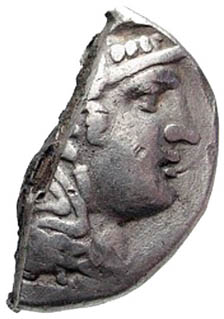
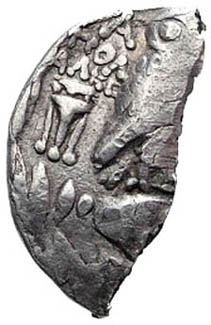
Ancient counterfeit fourree New Style Owl tetradrachm, cut in half (7.1g), c. 2nd-1st century BC. Official coins were sometimes cut in half in ancient times to make change, particular in areas that treated coins as bullion. This is an unofficial coin, however, an ancient counterfeit. It appears to be cut nearly exactly in half, with this half weighing 7.1 grams, about a gram and a half lighter than it would weigh if pure silver. The cut edge reveals a thin plating of silver and a dark brown/black interior. Filing a small part along the cut edge revealed the orangey bronze. Some of the plating from the obverse had previously been pushed into the interior of the edge, indicating it had been cut on the obverse. Perhaps this piece was considered good money in ancient times, was cut in half to make change, and only then did it became apparent what it was, which caused it to be discarded, tossed onto the ground or into the woods, with only half of it recently recovered. Or perhaps its light weight gave it away in ancient times and it was cut into pieces to deface and demonetize it. |
|
|
|||||
|
|
|
|
|
|
|
|
|
|
|
|
|
|
|
|
|
|||||
|
|
|
|
|
|
|
|
|
|
|
|
|
|
Here are other pages of mine on Ancient Fourree Counterfeits. |
|
|
|||||
|
|
|
|
|
|
|
|
|
|
|


Other glomworthy coins:
Coin sites:
Coin Collecting: Consumer Protection
Guide
Glomming: Coin Connoisseurship
Bogos: Counterfeit Coins
Pre-coins
© 2013 Reid Goldsborough
Note: Any of the items illustrated on these pages that are in my possession are stored off site.