|
|
The ancient Athenial Owl tetradrachm has been honored as
well in modern times by makers of exonumia -- medals, tokens, and commemorative coins. All or part of the Owl design
has been featured on many interesting pieces over the years, with those below being just a small sampling. They're
from six different continents -- Europe, North America, South America, Australia, Asia, and Africa -- in gold,
silver, bronze, and pewter and representing each decade except the 1940s from the 1930s to the 2000s. |
|
|
|||||
|
|
|
|
|
|
|
|
|
|
|
|||||||||
|
|||||||||
|
|
UNESCO 1978 commemorative bronze medal (116.0g, 59mm). This large bronze medal features on the obverse a portrait of Aristotle (384-322 BC) based on a sculpture in the Kunsthistoriches Museum in Vienna, along with the legend ARISTOTELIS (Aristotle) in Greek letters. The reverse depicts an owl from the ancient Athenian Owl, a map of Greece with a star referring to the location of Stagiros in Macedonia, which was Aristotle's birthplace, and a quote from Aristotle that translates into "The energy of the mind is the essence of life." The medal was minted to commemorate the the 2300th anniversary of the Greek philosopher's death in conjunction with a 1978 UNESCO (United Nations Educational, Scientific and Cultural Organization) conference in Paris, where the UN agency has its headquarters. It was designed by Max Léognany, whose last name appears under Aristotle's neck, and cast by the Paris Mint in gold and silver as well as bronze. The medal is beautifully patinated but low relief compared to most medals. The same portrait of Aristotle on the obverse of this medal was used on the reverse of Greek 5 drachmas coins minted from 1976 to 2000. |
|
|
|||||
|
|
|
|
|
|
|
|
|
|
|
|||||||||
|
|||||||||
|
|
World Almanac 1968 centennial anniversary silver medal (35.0g, 38mm). This .999 silver medal was made by the Medallic Art Company for the Newspaper Enterprise Association, publisher at the time of the World Almanac. The obverse of this beautifully crafted medal depicts a map of the world by sinusoidal projection, an open book, and the inscription, "THE AUTHORITY FOR 100 YEARS/THE WORLD ALMANAC/1868-1968." The reverse depicts a Classical Owl and a lamp of knowledge, the latter like the owl symbolizing the quest for wisdom. Two edge inscriptions, not visible in this photo, read, "Medallic Art Company" and ".999+ Pure Silver." The World Almanac was first published in 1868 by the New York World newspaper, then later by Joseph Pulitzer. In 1894 its name changed to The World Almanac and Encyclopedia and then in 1923 to its current name, The World Almanac and Book of Facts. It's currently published by Reader's Digest. |
|
|
|||||
|
|
|
|
|
|
|
|
|
|
 |
|||||||||
 |
|||||||||
Society of Medalists 1970 40th anniversary bronze medal (168g, 77mm). This large and stylishly designed diamond-shaped medal, cast in bronze and hand patinated by the Medallic Art Company, was made in 1970 to celebrate the 40th anniversary of the Society of Medalists. Along with the number "40," the obverse depicts conjoined designs of the obverse of the Society of Medalists' first medal (ruffled grouse) and the reverse of the 80th medal (Apollo 11 astronaut stepping on the Moon). The reverse depicts an owl in relief on the left and intaglio on the right along with the other elements on the reverse of Early Classical Owls. The reverse inscription reads, "Perpetuating the Ancient Art of Medallic Sculpture." The 80 border disks, 40 on each side, represent the 80 art medals issued by the society from 1930 to 1970. The society issued two medals a year until 1995, 129 in all. This particular specimen was one of 657 40th anniversary medals issued in bronze, with 125 issued in silver. |
|||||||||
 |
|||||||||
 |
|||||||||
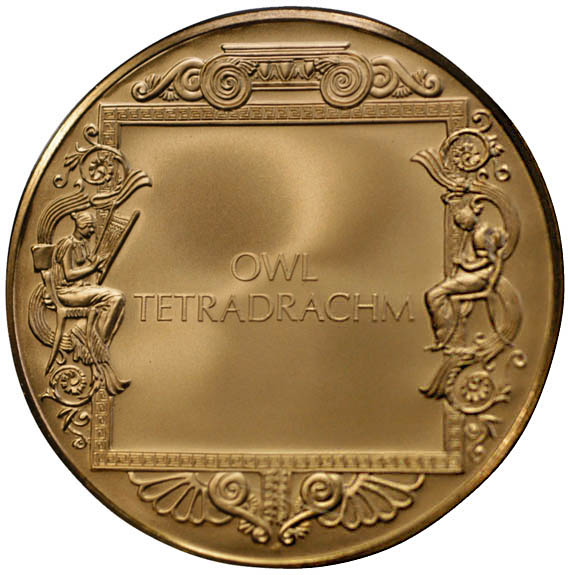
Franklin Mint gold-plated bronze proof medal (80g, 51mm [2.0 in.]). Here's an attractive medal made for collectors from the Franklin Mint's 50-piece set "The Art Treasures of Ancient Greece," created in 1980. The obverse, which has a mirror proof surface, features an owl from Early Classical Owls in which the tail feathers are individually delineated. The reverse, which has a frosted proof surface, identifies the coin in English and features two ancient Greek women wearing chitons, the one on the left playing a lyre, the one on the right a flute. Connecting them is a square meander border, with an Ionic order at the top and other ancient Greek motifs interspersed throughout. On the edge, not visible in this photo, is the inscription "GOLD ELECTROPLATE ON BRONZE" plus four symbols, a copyright symbol, an FM monogram, which is the "Franklin Mint" logo, the number 85 within a square, which indicates the medal was minted in 1985, and the letter P within a square, which means "Proof." The Franklin Mint is a private collectables maker that was founded in 1964 and is based in Exton, PA. Along with medals and coin replicas, it currently also manufactures model cars and motorcycles, jewelry, dolls, and figurines. The Franklin Mint also made a miniature proof sterling silver replica of a Classical Owl, part of its 100-piece set "The Solid Sterling Silver Miniatures of the World's Greatest Coins." |
|||||||||
 |
|||||||||
 |
|||||||||
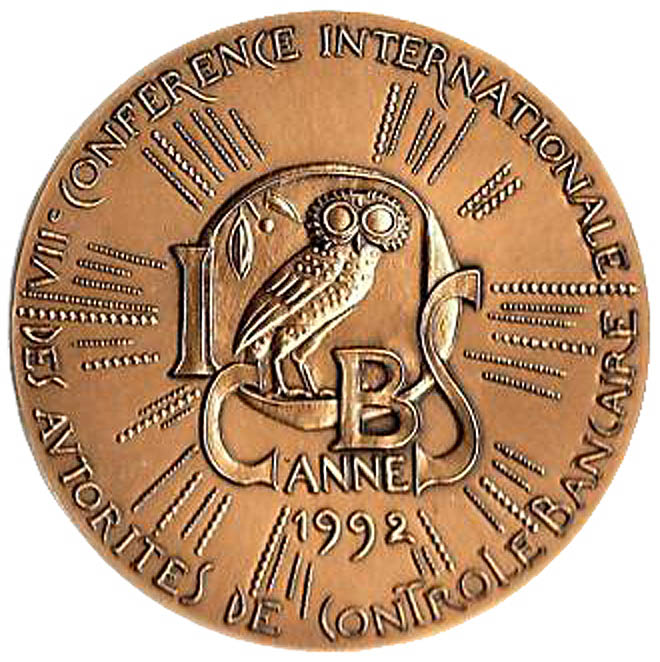
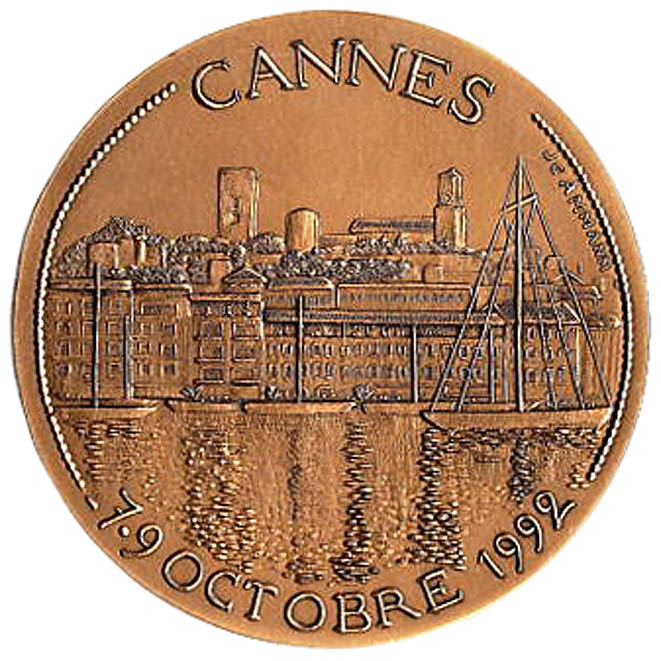
International Conference of Banking Supervisors 1992 bronze medal (200g, 70mm). This very large, very thick bronze medal was issued for the Seventh International Conference of Banking Supervisors, which was held in Cannes, France, in 1992. The obverse depicts the reverse of a Classical Owl (though it's missing the crescent moon) and a legend in French that translates into "Seventh International Conference of Banking Supervisors, ICBS." The reverse illustrates the Old Cannes harbor and is signed by the designer, J.C. Ammann. "Bronze" appears on the edge in tiny letters. The Owl motif was selected, according to the insert, because it calls to mind money trading, because the owl is an attribute of Athena, goddess of wisdom, and because the keen eyesight of owls is able to detect matters that escape unwitting eyes. The ICBS, which has been held mostly every two years since 1979 to promote cooperation among national authorities in the supervision of international banking, is run by the Basel Committee on Banking Supervision, in Basel, Switzerland, with members from Belgium, Canada, France, Germany, Italy, Japan, Luxembourg, the Netherlands, Spain, Sweden, Switzerland, the United Kingdom, and the United States. |
|||||||||
|
|||||||||
|
|||||||||
|
|
Tasmanian Teachers Credit Union 1988 bronze medal (19.8g, 38mm). This attractive bronze medal was issued to commemorate the Australian Bicentennial in 1988. The Tasmanian Teachers Credit Union sponsored the Money Room of the Tasmanian Museum and Art Gallery, which houses a genuine Owl tetradrachm. The ancient Athenian Owl design was chosen, according to a spokesperson at the museum, because of its historical interest and symbolism. The obverse playfully depicts a modern rendition of this ancient symbol of wisdom. Tasmania is a state of Australia and consists of the island of Tasmania and other surrounding islands south of the Australian mainland. The Tasmanian Devil is a carnivorous marsupial the size of a small dog found exclusively in Tasmania that makes a loud screeching growl. |
|
|
|||||
 |
|||||||||
 |
|||||||||
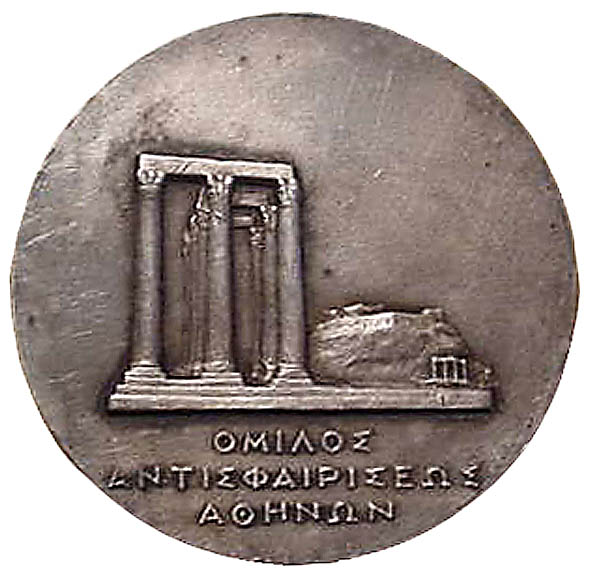
Athens Lawn Tennis Club 1939 silver medal (91.6g, 44mm). Here's an old attractive large silver medal commemorating tennis at the Athens Lawn Tennis Club. The obverse features an owl from Classical Owls standing on the logo of the tennis club, which is comprised of the initials OAA for Omilos Antisfairiseos Athenon or "Athens Tennis Club." The obverse legend, TON ATHENETHEN ATHLON or "Of the games at Athens," is the same legend that was used on ancient Panathenaic amphoras filled with oil that were used as prizes at the ancient Athens Games. The last part of what looks like the obverse legend, ATLO, is actually the date and stands for 1000-900-30-9, or 1939, the year this medal was issued. The last number in the date wasn't engraved into the die but instead was engraved into the medal itself, no doubt to allow for dating flexibility. The reverse features the ruins of the Temple of Zeus Olympios, which is located near the club, with the Acropolis in the background. The reverse legend reads OMILOS ANTISFAIRISEOS ATHENON or "Athens Tennis Club." Both obverse and reverse inscriptions were written in katharevousa, a form of the Greek language combining elements of ancient and modern Greek that avoided Turkish words and that was used for official purposes in the 19th and 20th centuries. In the 19th century when it became independent modern Greece went through something similar linguistically to what Israel did in the 20th century when it became a country, trying to honor the ancient while making the language living. The reverse also features the signature of the engraver, just under the Acropolis all the way to the right, though it's not visible in the photo. The tiny letters aren't neatly formed, however, which makes it difficult under either a 10x or 16x loupe to decipher them exactly. The same medal exists in bronze. These are probably commemorative medals sold to attendees at a tournament, though they could be a prize medals awarded to athletes. This medal was issued in 1939, only a year before the start of the Greco-Italian War, when the Greeks pushed out the invading Italians, and the subsequent Battle of Greece, when Germany conquered Greece. The eBay seller of this piece, an established coin dealer, described it as "maybe silver." But it has same look and feel as silver and unlike pewter or copper-nickel it rings like a bell, so it undoubtedly is silver, perhaps sterling silver (.925 silver). Unlike with some other medals, there's no edge marking indicating the alloy. This buy was cherrypick in among other ways that it sold for considerably less than the bullion value of the silver in it. The piece appears to have been produced with a machine press, with no signs of casting on the edge or surfaces. It has a few light scratches and dings but nothing major or surprising for a heavy medal that's been around for more than 70 years. |
|||||||||
|
|
|
|
|
|
|
|
|
|
|
|||||||||
|
|||||||||
|
|
National Bank of Greece 1966 125th anniversary bronze medal (155g, 70mm). This large bronze medal was issued in 1966 in commemoration of the 125th anniversary of the National Bank of Greece. It features on the obverse a bust of Georgios Stavros, the bank's founder and first governor, who lived from 1788 to to 1869. The reverse is signed by the designer, M. Tombros (Michalis Tombros) of Athens, Greece. The medal was minted by Messrs. Picchiani e Barlacchi of Florence, Italy. The National Bank of Greece, founded in 1841, is the oldest and largest commercial bank in Greece. It issued paper money until the establishment of the Bank of Greece in 1928. Georgios Stavros' portrait also appeared on Greek paper money. |
|
|
|||||
|
|
|
|
|
|
|
|
|
|
|
|||||||||
|
|||||||||
|
|
Georges Clemenceau 1931 bronze medal (400g, 90mm). This huge high-relief bronze medal depicts on the obverse a portrait of Georges Clemenceau, France's prime minister at the end of World War I who lived from 1841 to 1929. The medal was struck in 1931 by the Paris Mint (Monnaie de Paris), France's official mint, and according to a spokesperson at the mint's museum, the reverse of an Athenian Owl was chosen for its reverse to confer honor to Clemenceau because of its symbolism of carefulness, intelligence, and wisdom. It was designed by François-Léon Sicard, a noted French sculptor, and was signed F. Sicard by him on the obverse. The reverse actually depicts the reverse of an Archaic Athenian Owl, which lacks the crescent moon of later and much more common Classical Owls. The reverse legend portrays the Greek letter theta in its modern form, with a horizontal bar instead of a dot in the center. |
|
|
|||||
|
|
|
|
|
|
|
|
|
|
|
|||||||||
|
|||||||||
|
|
Iwar Sjögren 1953 bronze medal (90g, 56mm). This is another large medal using the wisdom symbolism of the ancient Athenian Owl motif to honor an individual, in this case Iwar Sjögren, who was a chief executive officer of Skandia, a multinational Swedish insurance company that was started in 1855 and currently has operations in Europe, Latin America, Asia, and Australia. Sjögren lived from 1888 to 1972, with this medal issued in 1953, the year of his 65th birthday. The obverse depicts a portrait of Sjögren. The numbers 24-XI signify November 24th, Sjögren's birthday. The reverse, along with an owl from the the ancient Athenian Owl, depicts an oak sprig (instead of an olive sprig), a torch and hour glass, "Klokhet" or "Wisdom," "Kunskap" or "Knowledge," "Kultur" or "Culture," "Skandia," two quatrefoils (heraldic representations of a flower with four petals), and C-G for Gösta Carell, the engraver. Another version of this metal was issued in .830 silver. Still another version was issued in 1958, the year of Sjögren's 70th birthday, and has 1958 instead of 1953 engraved on the obverse, according to an email I received from his grandson, Gustaf Sjögren. |
|
|
|||||
 |
 |
||||||||
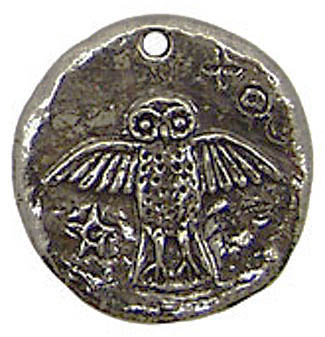
Green Girl Studios jewelry medal (7.3g, 26mm). Here's a cast piece made of lead-free pewter with a hole in it, meant to be worn as jewelry. Its obverse is patterned after Early Classical Owls. According to the designer, the owl on the reverse was intended as a baby owl. Coincidentally, however, its frontal open-winged posture is reminiscent of the owls on Athenian trihemiobols. The star on the reverse is the designer's signature. The lettering on the reverse was intended merely as another design element and has no meaning. The lettering on the obverse is a loose approximation of the Owl ethnic. This jewelry piece was designed and made by Cynthia Thornton of Green Girl Studios, a jewelry design studio in Asheville, NC. It sells these and similar works through its Web site and at jewelry shows as well as through third-party jewelry supply outlets. |
|||||||||
 |
 |
||||||||
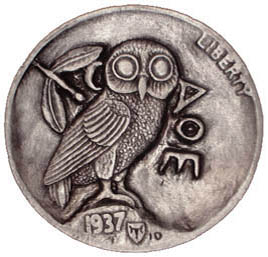
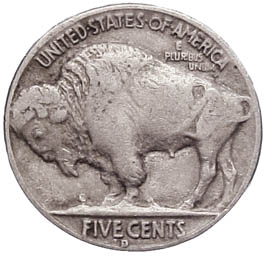
Owl hobo nickel (4.52g). This Hobo nickel was made from a 1937-D Buffalo nickel. To the right of the date there's an HT monogram inside a shield for the engraver's name, Howard Thomas, who sells his originally engraved Hobo nickels of different designs on eBay using the I.D. memiki*redwolf. The 10 is for 2010, the year this piece was made. It weighs 4.52g compared with 5.00g for an unadulterated Buffalo nickel, indicating it lost slightly less than half a gram of metal or 10 percent of its weight from the reengraving. Thomas, of Fort Wayne, IN, also runs a business called Sailors Dream Scrimshaw. The reengraving of Buffalo nickels as an art form was popular from their inception in 1913 because of the coin's low cost and because the large Indian head on the obverse gave artists a large canvass to work with. Other types of coins have been reengraved before and afterward, though Buffalo nickels are the most popular U.S. coin used for this purpose. Buffalo nickels continued to be reengraved after the U.S. Mint changed to Jefferson nickels in 1938, and this continues today. Some Buffalo nickels minted in 1937 in Denver, such as the above coin, come in a "three-legged" variety, with part of the buffalo's right front leg missing, though this coin isn't this variety. The name "Hobo nickel" comes from the fact that hobos, using crude tools such as nails and knives, were among those creating these miniature bas reliefs in the early 20th century. Thomas on the other hand uses a small rotary tool and assorted hand tools under a microscope. He says that each piece takes him from 7 to 20 hours of work. Hobo nickel artists sometimes reengrave both sides, while other times as with this piece they preserve the buffalo reverse side. The pairing of this particular owl rendition, a unique and historically important symbol for ancient Greece, and this particular rendition of the American bison, a unique and historically important symbol for the modern United States, is visually compelling. The Original Hobo Nickel Society is for Hobo nickel enthusiasts. Coins have been reworked in one way or another and for different purposes since the inception of coinage and continuing on to today. This no doubt is an incomplete list of deliberate post-mint coin alteration: test cut (authenticated), countermarked (authenticated, legalized, retariffed, sign of ownership), marked with graffiti (love tokens, promotions, vanity, defilement, political statements, attempted art), holed (jewelry, good luck charms, buttons, means of carrying), cut into halves or other fractions (small change, defilement), bent (good luck charms, love tokens, defilement), reengraved (potty coins, love tokens, hobo nickels, parody coins), flattened (railroad coins), flattened and reengraved (elongated coins), painted (attempted art), electroplated (novelty, deception), fields tooled away (cut-coin jewelry), two-headed or two-tailed (novelty, magician's trick), shrunk (novelty), hollowed (to carry messages), doctored (deceptively enhanced details, deceptively removed defects, deceptively changed variety or type). In the U.S. at least, coin alteration is legal so long as it's not done fraudulently -- to deceive others -- as it is with doctoring. Interestingly, the U.S. Mint discourages coin alteration while recognizing its legality. It is illegal in the U.S. to melt cents and nickles for their bullion value, with this law becoming necessary in 2006 when the bullion value of these coins exceeded their face value. |
|||||||||
 |
|||||||||
 |
|||||||||
The Elongated Collectors 1981 15th Anniversary medal (2.40g, 34x18mm). This elongated coin was made from a 1926 U.S. Mercury dime to commemorate the 15th anniversary of The Elongated Collectors (TEC) in 1981. The Classical Athenian Owl design is a favorite of TEC, appearing on most of its membership coins. Elongated coins are pressed using a jeweler's mill, with the design engraved into one of its two steel rollers, which imparts the design to the coin and stretches it out. The pressing effect is similar to what happens when you place a coin on a railroad track to be run over by a train. The process cost the dime 0.1g or 4 percent of its weight. Elongated coins, which are quite legal, are often sold as souvenirs at museum and landmark gift shops, zoos, amusement parks, county fairs, and other touristy locations. Cents are used most often, but other coins and blank copper slugs are used too. The first elongated coins in the U.S. are thought to have been created at the World's Columbian Exposition of 1893 in Chicago. The above piece looks similar in hand as in this photo, with the obverse having an orange cast and the reverse being shallowly engraved. |
|||||||||
|
|
|
|
|
|
|
|
|
|
|
|||||||||
|
|||||||||
|
|
Banca Nazionale del Lavoro pewter token (45.5g, 43mm). This darkly toned lead-based pewter token was issued by Banca Nazionale del Lavoro (BLN), an Italian bank in Argentina, probably as a promotional item. The owl's body is positioned forward, as on Athenian dekadrachms and some fractions, rather than to the right, as on most tetradrachms. The AQE ethnic on the obverse is missing the A from ancient Owls, and there's no crescent moon. The reverse legend reads, "Your exploits have their reward." Unlike most of the other pieces on this page, it was deliberately made to affect the appearance of antiquity. I'm not aware of when this token was made or the specific circumstances surrounding its issue. |
|
|
|||||
|
|
||||||||
|
|
Greek National Archaeological Museum pewter token (3.6g, 20mm). This pewter token was distributed by Greece's National Archaeological Museum in the 1960s. The reverse of this token reads: "Athens tetradrachm/Fifth century BC." The Roman numeral "III" indicates that this piece is the third of a series of similar tokens from the museum honoring ancient coins. It's unclear what the iconography below the legend signifies. On the obverse, the theta is missing a central dot. The National Archaeological Museum, originally named the Central Museum, was established in 1829, the same year that modern Greece gained independence from Turkey. Residing first on the island of Aegina, it has been situated in Athens since the late 1800s and is Greece's largest museum. The Greek government along with the governments of Italy, Turkey, and other source countries for ancient coins and artifacts are trying to "repatriate" items made in ancient times on ground now governed by these countries that now reside in museums and collections of other countries. Yet Greece's Hellenic Ministry of Culture boasts about how impressive is the National Archaelogical Museum's collection of Egyptian and Near Eastern antiquities. |
|
|
|||||
|
|
|
|
|
|
|
|
|
|
|
|
||||||||
|
|
British Petroleum pewter token (4.1g, 20mm). This pewter token, which has the same obverse and same flan shape as the above National Archaeological Museum token, was given away with other ancient coin tokens as premiums at British Petroleum petrol (gas) stations in France in the early 1970s. The reverse reads: "The Treasure of Ancient Money, BP Collection, Athenian Tetradrachm, 5th Century BC." Similar tokens, with legends in Dutch, were given away in the Netherlands. British Petroleum, now known as BP, is a multinational oil company headquartered in London. It had its origins searching for oil in Persia, current-day Iran, in the earlier 1900s and today is the third largest oil company in the world behind ExxonMobil and Royal Dutch Shell. |
|
|
|||||
|
|
|
|
|
|
|
|
|
|
 |
|||||||||
 |
|||||||||
Geocaching 2008 pewter token (43.8g, 45mm). Like the above two pieces, this is another pewter token, though it's considerably larger, is new, and was minted in China. It's a nicely designed and crafted token with an antique matte finish honoring ancient Greece with an owl from Classical Owls on the obverse and the Parthenon on the reverse. This and similar tokens, or "geocoins," are used by aficionados of "geocaching," which is a treasure hunting game based on the Global Positioning System (GPS). Participants use handheld GPS units that connect to one of the GPS satellites orbiting the Earth in order to find "treasures" such as this token, which they hide under rocks in the woods and similar places. When you find a cache, you take something from it and replace it with something else. Other items that people hide in these caches include books, software, hardware, CDs, and videos. You can learn more at Geocaching.com. This particular geocoin has a tracking number, which lets people track through this Web site where this token has been and the experiences people have had in finding it. |
|||||||||
 |
|||||||||
 |
|||||||||
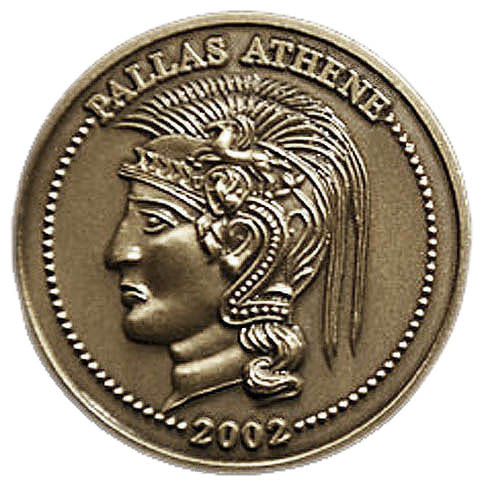
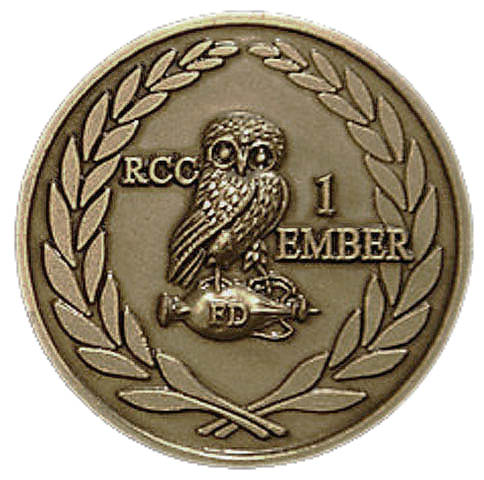
Rec.collecting.coins 2002 bronze token (32.1g, 40mm). This odd-looking token, consisting of bronze with an antique brass finish, was made for rec.collecting.coins (RCC), a Usenet discussion group about coins. This was the group's first such token, with five different tokens in all eventually produced. The above token was made in 2002 by Quality Challenge Coins of Harrisburg, PA, which subcontracted with a private mint called World Shop in Seoul, South Korea. In all 121 pieces of this type were produced, though three were lost, and the dies were destroyed afterward, preventing further production. The initial price was $10, but they soon were being offered on eBay. Hammer prices exceeded $100 but settled down to an average of $30 to $40 by the mid-2000s. The project was spearheaded by George V. Huse Jr., a participant in the discussion group. The circumstances behind the minting of this token, which I witnessed firsthand, also present an interesting example of the issue of Internet misinformation. Unlike the vast majority of other medals and tokens inspired by ancient Athenian Owl coins, this piece isn't based on the famous Classical Owls of the fifth century BC, minted during the Athenian golden age, but on the less important New Style Owls of the second and first centuries BC, after Greece had lost its independence and was under the hegemony of Rome. As opposed to the actual ancient coins, Athena is facing left on this token rather than right because Huse was led to believe that if this copy had been made with a right-facing Athena it might be regarded as a forgery or might be modified and sold as an authentic ancient coin. This is despite the fact that this token is considerably larger and heavier than ancient coins of this type, that it's made of a copper alloy whereas the ancient tetradrachms were made of silver (ancient bronzes of this type exist but they're even smaller and are seen far less), that it was manufactured with a modern press and has a perfectly round shape, flat fields, and uniform rims and other design elements as opposed to the irregularity of ancient hand-struck coins, that it features modern Latin lettering and Arabic numbering, which no ancient Greek coins had because such lettering and numbering hadn't yet come into existence, and that many other medals, tokens, and other modern works use the ancient Owl as inspiration, as these pages show. Further, the model used for this token wasn't a genuine New Style Owl because some RCC participants convinced Huse that using a photo from a coin book for design guidance could result in a copyright violation. For some reason no genuine specimens of this common coin type were available for a scan or photo and no attempt was made to ask for the use of anyone's existing scan or photo, many of which exist online. So instead Huse purchased Slavey replica of a New Style Owl tetradrachm, made a scan of it, and sent the scan to the minter even though Slavey replicas have a reputation at least among those who know ancient coins for their flamboyant exaggeration. Unlike with genuine New Style Owls, which feature Athena with a pleasant smile or neutral expression, Athena on this piece has an unpleasant scowl. Another anomaly is the obverse legend "Pallas Athene," which never appeared on ancient coins of this type and which misdescribes the Athena that's illustrated. Pallas is one of the many epithets sometimes used as part of Athena's name, in this case signifying an opponent she killed in battle whose name she took. But the epithet used with Athena on New Style Owls in coin books and coin catalogs is Parthenos, not Pallas, as in Athena Parthenos, since the image used on these coins is thought to have been based on the sculpture of Athena by Phidias that stood in the Parthenon. Instead of the English spelling "Athena," the spelling most commonly encountered in books on numismatics and mythology, the much less seen spelling "Athene" is used. This is closer to, though not exactly, the Greek spelling of the goddess' name, which is Alpha Theta Eta Nu Eta or "Athênê." The reason for the English spelling is that the pronunciation and transliteration of "Athênê" is "Athena." Two further anomalies are an owl that's smaller than on authentic New Style Owls and a wreath around the coin's edge that's larger, with the wreath taking up far more space even though the owl by far is the more important design element. On the obverse of this medal, 2002 designates the year these pieces were minted. On the reverse, 1 ember is a fictional denomination, and FD on the amphora (wine jug) that the owl is perched on stands for Flamedrake, which is the name of the dragon that Huse designated as the unofficial mascot of RCC. Among the ironies here is that flames, which are loud and argumentative or insulting posts, are the most distinctive characteristic of these kinds of unmoderated discussion groups, with the loudest and least informed often drowning out others, as happened here. |
|||||||||
 |
|||||||||
 |
|||||||||
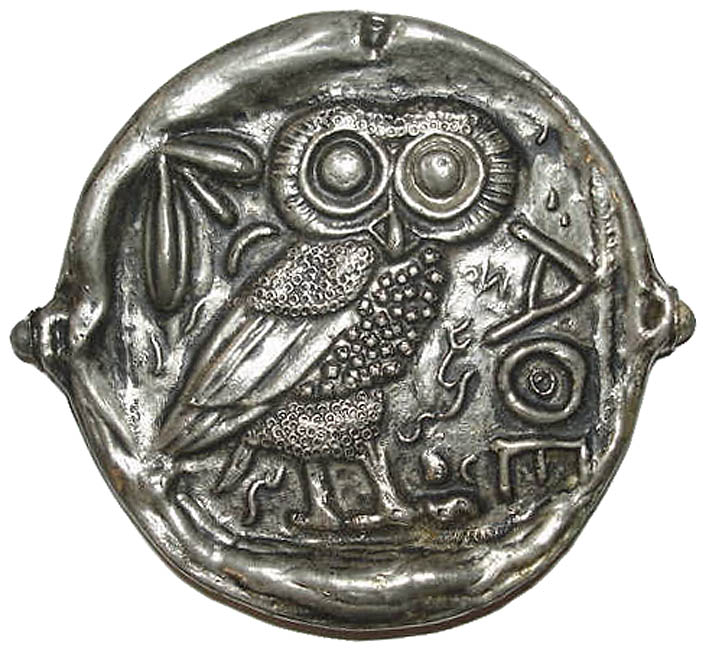
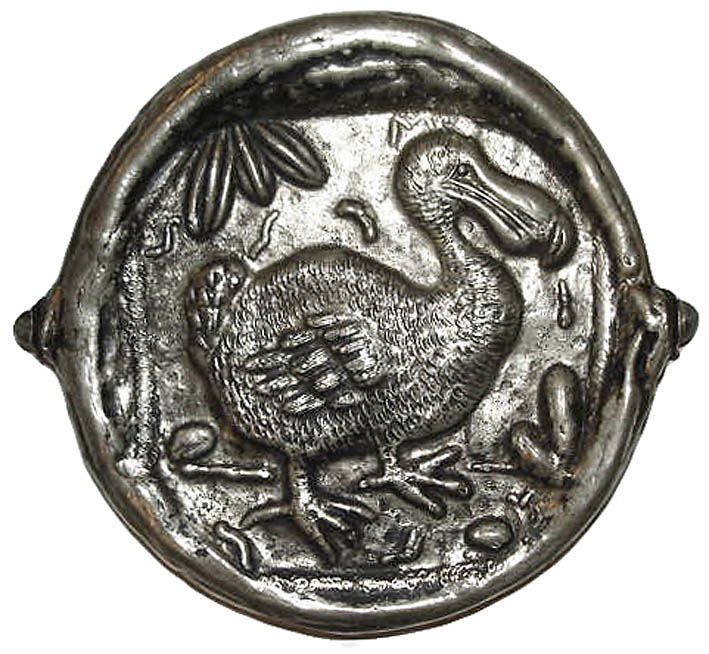
Proctor & Gamble token (107g, 70mm). This curious piece was part of a promotion by Proctor & Gamble Co. for Crest toothpaste given to dentists in the late 1960s. It was attached to a metal base that allowed you to spin the token to easily see both sides, with the two protruding connectors at the sides used to attach it to the base. The token features on one side an owl, a bird that symbolizes wisdom, and on the other a dodo, a bird that symbolizes stupidity. Wording on the base described the wisdom and stupidity symbolism and then said: "For the patient confused or uninformed about Dental Matters and Denti-Prices, chance largely determines whether he acts wisely or unwisely. As his knowledge increases, so does the wisdom of his decisions." The token appears to have been cast in pewter, with a pronounced edge seam. The obverse features an owl, olive sprig, crescent moon, and ethnic from Classical Owls (the theta in the ethnic instead of having a dot in the middle has a dot within a circle), plus various shorter and longer squiggles. The reverse features a dodo, olive sprig, crescent moon, and various squiggles. Dodos are extinct flightless birds related to pigeons. They lived on Mauritius, a small Indian Ocean island west of the larger island of Madagascar off the east coast of Africa, and today the dodo rampant appears on Mauritius' coat of arms. Though Arab and Malay sailors knew of Mauritius as early as the 10th century and Portuguese sailors first visited the island in 1507, Mauritius was uninhabited by humans until it was colonized the Dutch in 1638. Dodos went extinct in the mid-to-late 17th century from being attacked by the dogs, pigs, and other animals that Dutch colonists brought to Mauritius and from the human destruction of the forests in which dodos lived. Dodos are the poster child of extinct species because they went extinct during recorded history and because their extinction is directly attributable to human activities. Hence the expressions "going the way of the dodo" and "dead as a dodo." Dodos are thought of as dumb birds, with one dictionary definition of "dodo" being a "stupid person." Their extinction, however, wasn't their fault. They appear to have been well adapted to their pre-human environment. Dane Kurth on her marvelous "Helvetica's Feathered Friends" page illustrates another specimen of this same token. |
|||||||||
 |
 |
||||||||
Congo 2003 gold commemorative coin (1.24g, 14mm).
This commemorative coin was minted in 2003 and 2004 and is seen with both dates. Congo issued 25,000 of these pieces, and it's seen on the secondary market quite often. Congo also issued a larger version of the above coin, weighing one-half of a troy ounce, 30mm in diameter, and having a nominal value of 75 francs, with only 500 of these larger pieces struck. Another African country, Sierra Leone, also issued commemorative coins for the Athens Olympics that depict an owl from Athenian Owls, two different types, but with both the owl is a small subsidiary device.
|
|||||||||


Other glomworthy coins:
Coin sites:
Coin Collecting: Consumer Protection
Guide
Glomming: Coin Connoisseurship
Bogos: Counterfeit Coins
Pre-coins
© 2013 Reid Goldsborough
Note: Any of the items illustrated on these pages that are in my possession are stored off site.