|
|
|
Owls have been copied not only by scammers trying to cheat
unsuspecting buyers, but also legitimately by museums and commercial replica makers, with no intent to deceive. |
|
|
|||||
|
|
|
|
|
|
|
|
|
|
|
|
|
|
||||||||
|
|
|
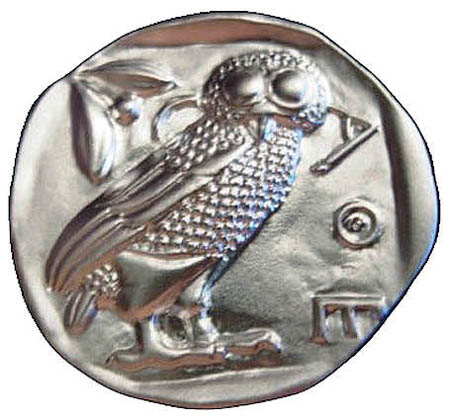
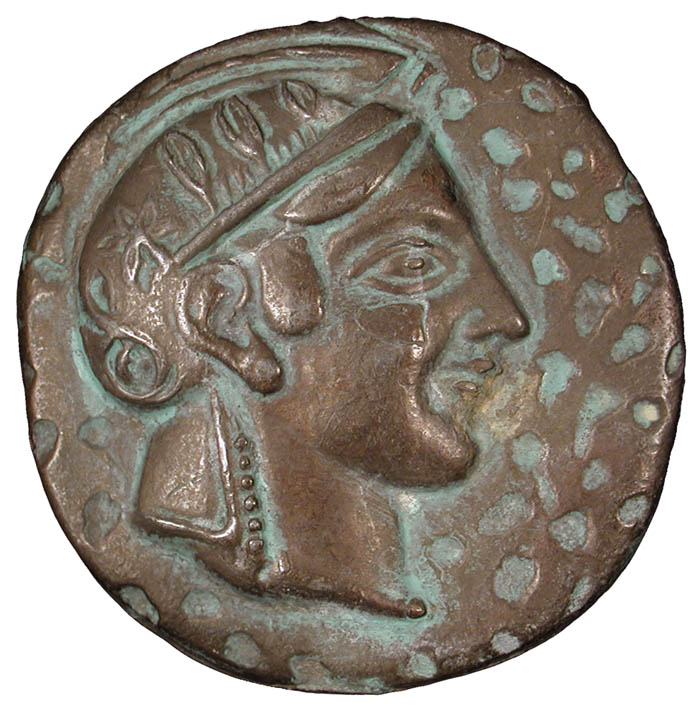
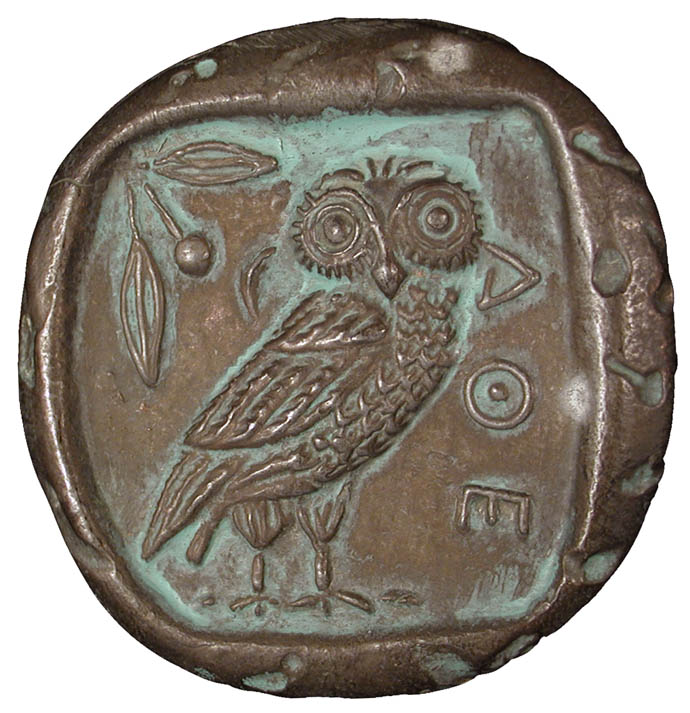
Mayer & Wilhelm 19th century electrotype replica Archaic Owl tetradrachm (16.1g). This is one of a large group of attractive unmarked replicas sold during
the summer of 2006 on eBay by a volume seller from Germany. He referred to them in his auction descriptions only
as "repros," without any other identifying information, and sometimes not attributing the coin that the
replica copied. |
|
|
|||||
|
|
|
|
|
|
|
|
|
|
|
|
|
|
||||||||
|
|
|
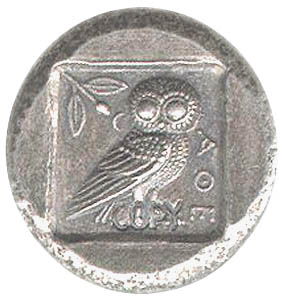
Gallery Mint Museum replica Early Classical Owl tetradrachm (18.3g). This is a high-quality but heavy pressed replica made of .999 fine silver by Gallery Mint Museum of Eureka Springs, AR. It has a "COPY" countermark on the reverse, which on these particular replicas is sometimes at the owl's feet, as on the above piece, and sometimes below this outside the incuse square. This replica copies an Early Classical Owl, Sear 2518. |
|
|
|||||
|
|
|
|
|
|
|
|
|
|
|
|
|
|
||||||||
|
|
|
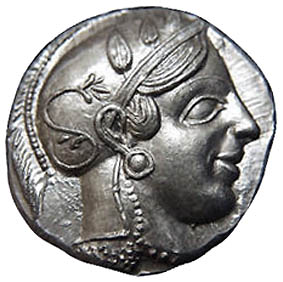
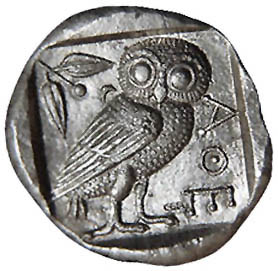
Slavey replica Early Classical Owl tetradrachm (16.7g). This high-quality pressed replica, made of .950 silver, is one of the finer works of the Bulgarian replica maker Slavey Petrov, who goes by his first name, Slavey. Charactistically, the details are beautifully though flamboyantly rendered. The fields on this specimen are overflat, noticeable in particular on the reverse outside the incuse, though this isn't the case with all Slavey Owls. It has an "SL COPY" countermark on the edge (not visible in this photo). This replica copies an Early Classical Owl, Sear 2521. More on Slavey replicas. |
|
|
|||||
 |
 |
||||||||
Copy of Slavey replica Early Classical Owl tetradrachm (13.3g). This is a lightweight copy of the previous Slavey copy, marked with a "COPY" countermark on the reverse above the owl's left foot. I haven't seen this one in hand, however. These were put up for auction on eBay by a volume seller of ancient coin replicas in St. Petersburg, FL. Only the piece sent to buyers wasn't the above but a common cast forgery of lesser quality without a "COPY" mark. The seller said no one else complained, but she accepted the return. |
|||||||||
|
|
|
|
|
|
|
|
|
|
|
|
|
|
||||||||
|
|
|
Antiquanova replica Early Classical Owl tetradrachm (17.2g). This high-quality pressed replica, made of .999 silver, is from the Czech coin replica maker Antiquanova. An S countermark, for the engraver Petr Sousek, appears either to the right of the owl's legs, as on this specimen, or under the owl's tail feathers. This replica also copies an Early Classical Owl, Sear 2521. Antiquanova is one of the finest replica makers in the world, but this isn't one of its finest pieces, with Athena's helmet crest off the flan, too much empty space in front of Athena, and both Athena and her owl rendered unaesthetically. |
|
|
|||||
|
|
|
|
|
|
|
|
|
|
|
|
|
|
||||||||
|
|
|
Rosa replica Classical Owl tetradrachm (17.3g). This high-quality pressed replica, made of a lead alloy, is unlike most of the so-called Rosa replicas on the market today. It's an "original copy," a work of Peter Rosa, the American replica maker, not a later reissue from his molds. Rosa based many of his replicas on casts he bought from the British Museum. This replica is unmarked and was handled by a Mr. Siegel in 1963, according to the paper coin envelope this replica was in. The piece copies a Mass Classical Owl, Sear 2526. |
|
|
|||||
|
|
|
|
|
|
|
|
|
|
|
|
|
|
||||||||
|
|
|
Rosa/Doyle replica Classical Owl tetradrachm (11.1g). This is a lightweight silver-plated cast replica, made by Charles Doyle from Peter Rosa's molds, which he bought from Rosa's estate. Doyle also worked with Rosa, and he currently makes these replicas, which he sells on eBay. Though severely underweight and comprised of base metal, it's an attractive enough Owl replica, with well-chosen devices and nice surfaces. It's countermarked with "COPY" on the edge (not visible in this photo). The obverse of this replica is documented in Wayne Sayles 2001 book Classical Deception as No. 28. The Toronto Forger used this replica as the seed coin for one of his Owl forgeries. |
|
|
|||||
|
|
|
|
|
|
|
|
|
|
|
|
|
|
||||||||
|
|
|
Charlton Mint replica Classical Owl tetradrachm (10.5g). This is a lightweight pewter cast replica also made from Peter Rosa's molds, in this case by Charlton Mint of Saratoga Springs, NY. The replica is countermarked with "COPY" on the reverse to the right of the owl. It's smaller, thinner, and lighter than the Rosa/Doyle version, and it exhibits more obvious casting pits. |
|
|
|||||
|
|
|
|
|
|
|
|
|
|
|
|
|
|
||||||||
|
|
|
NT Ancients replica of Rosa replica (6.1g). This is a cast copy of the above Rosa replica but without a "COPY" countermark on the edge. Compared with both the Rosa copy and Charlton Mint copy, it's even thinner and lighter. It's a third-generation copy, or a copy of a copy of a copy. This piece is a product of NT Ancients of Quebec, Canada. |
|
|
|||||
 |
 |
||||||||
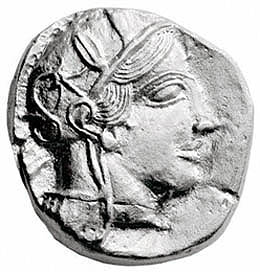
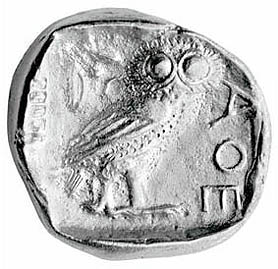
Gavia replica Classical Owl tetradrachm (16.0g). This is a cast replica from Gavia, a coin dealer in Germany. It was sold on eBay Germany as being .999 silver, weighing 17 grams, and being 26mm in diameter, but it's lighter at 16.01 grams and smaller at 24 millimeters at its widest. The surfaces exhibit pronounced casting pits and the edge is filed. The reverse is marked with "2005," which is likely the year of manufacture. |
|||||||||
|
|
|
|
|
|
|
|
|
|
|
|
|
|
||||||||
|
|
|
Museum Reproductions replica Classical Owl tetradrachm (13.3g). This cast copy, made of pewter, has an "R" countermark and was made by Museum Reproductions of Cheshire, England. This is an inexpensively made, and inexpensive, replica with large casting pits over its surfaces, muddy and indistinct details, and Athena rendered with her nose sliced in half. |
|
|
|||||
|
|
|
|
|
|
|
|
|
|
|
|
|
|
||||||||
|
|
|
Metropolitan Museum of Art replica Classical Owl tetradrachm (9.6g). This low-weight silver-plated brass cast replica was made for New York City's Metropolitan Museum of Art and sold by the museum's gift shop in large numbers in the 1950s and 1960s. This specimen like all of these particular replicas has a center dimple on the obverse, an edge cut at 8 o'clock on the obverse and 6 o'clock on the reverse, and prominent casting pits. This replica, made before the U.S. Hobby Protection Act was passed in 1973, isn't marked with a "COPY" or similar countermark. It's often auctioned on eBay as an authentic coin, though in many cases, not all, it appears that the seller doesn't know it's a replica. |
|
|
|||||
|
|
|
|
|
|
|
|
|
|
|
|
|
|
||||||||
|
|
|
Larson replica Classical Owl tetradrachm (17.2g). This hand-cut, struck copy is made of .900 fine silver and has a "COPY" countermark on the edge. It's a work of Charles Lawson, author of the quite informative but controversial 2004 book Numismatic Forgery, which sheds light on coin forgery by providing how-to tips. This replica is anything but convincing, however. It was originally but unrealistically styled, and the flan is very low relief in contrast to the evocatively high relief flans of ancient Owls. A gravity hammer machine was used to mint it instead of a hand-held hammer. It's the correct weight and diameter. |
|
|
|||||
|
|
|
|
|
|
|
|
|
|
|
|
|
|
||||||||
|
|
|
Wilbert replica Classical Owl tetradrachm (9.4g). This low-weight, undersize cast replica appears to be made of pewter, a tin alloy. This replica, which is unmarked, originally was part of a 12-replica set marked "Wilbertly Yours" on the box and was distributed in the 1960s and 1970s as a free promotion to business accounts by Wilbert Burial Vaults, currently Wilbert Funeral Services, of Broadview, IL. Wilbert also distributed sets of replicas of U.S. colonial coins and U.S. early Western coins. Despite the size and weight of the above Owl replica, it frequently appears on eBay as an authentic coin. |
|
|
|||||
 |
|||||||||
 |
|||||||||
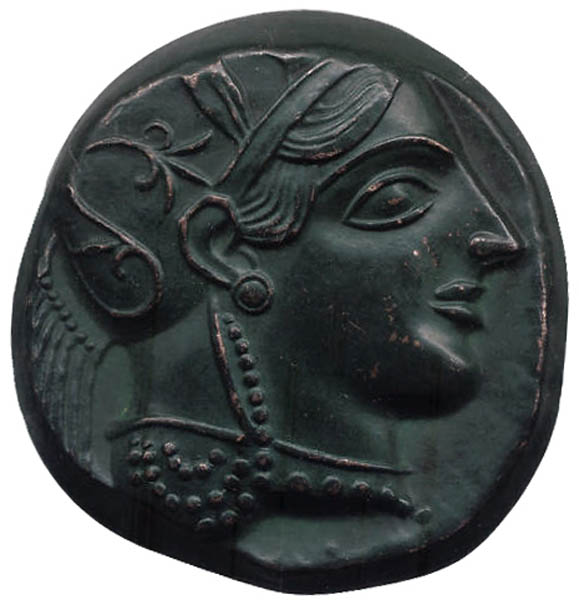
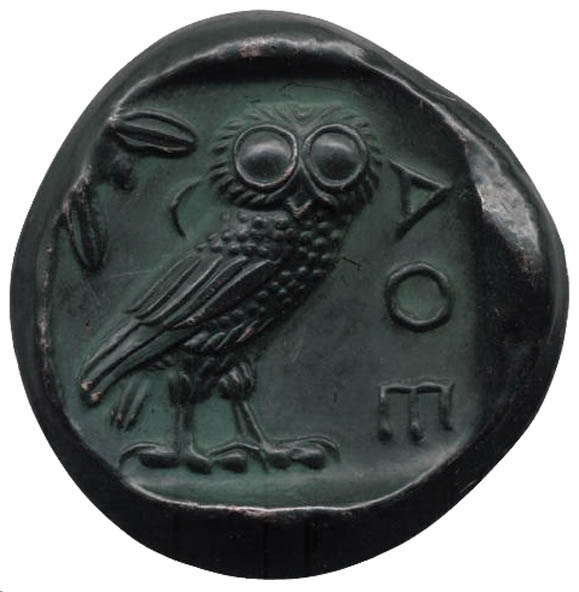
French copper replica Classical Owl tetradrachm (310g, 61mm, 17mm thick). This very large, old, and attractive off-metal replica was made by the Paris Mint, probably between 1880 and 1901. It was sold on eBay by a seller in France simply as an owl medal, though in email he did provide the information that the cornucopia design on the edge is a mint mark of the Paris Mint. Afterward I learned from Rich Hertzog World Exonumia that the Paris Mint used the cornucopia mint mark alone without a date only during the 1880 to 1901 time period. However, in a footnote this dealer site indicates that in some cases the Paris Mint used mint marks after the dates listed, so there's a possibility that this piece was minted later. Along with the cornucopia design, the edge also includes the French word "CUIVRE," which means copper, and N° 485/500, which indicates 500 of these pieces were made. The Paris Mint (Monnaie de Paris) is France's official mint and has been in operation since the early 1500s. It's not only responsible for France's coinage but also produces collector coins, medals, and replicas such as the above piece. The edge of this replica has a seam visible in part, indicating this piece was cast. Scattered file marks are also visible on the edge, which smoothed away most but not all of the seam. On most of the edge the file marks were also smoothed away. For a cast the details are sharp, and there are no pits, bumps, or other artifacts of lower quality casts. The styling isn't perfect in its fidelity to the original design of Mass Owls but is close. Like Owls this replica is high relief and thick, as thick compared with its diameter as an authentic Owl, which accounts for its substantial weight. The copper that the replica is made with has a dark brown patina with green undertones, and it has been inadvertently rubbed off, probably through handling or cabinet rub, over the years at some of the obverse and reverse highpoints. Overall this is a massive and impressive old replica, heavy in the hand and attractive. |
|||||||||
|
|
|
|
|
|
|
|
|
|
|
|
|
|||||||||
|
|
|||||||||
|
|
|
Bedouin soapstone replica Classical Owl tetradrachm (17.3g, 38mm). This is another large replica of a Classical Owl. It was made by a Saudi Arabian Bedouin, according to the ancient coin dealer who sold it to me. It's hand cut in soapstone, a soft lightweight metamorphic rock composed mostly of the mineral talc. No doubt purely by chance, this oversize piece weighs about the same as an authentic Owl. It's fairly crude but interesting. |
|
|
|||||
|
|
|
|
|
|
|
|
|
|
|
|
|
|||||||||
|
|
|||||||||
|
|
|
Cretan bronze replica Classical Owl tetradrachm (276g, 86/82mm). This is the least attractive of the three large Owl replicas here. It was said to have originated in Crete in the early 1960s, though it's unmarked with anything indicating its origin. It appears to be made of bronze. The green pockmarks on the obverse fields and the edge appear to be a clumsy attempt to simulate age. It copies a Mass Classical Owl, though Athena's sidelock is more reminiscent of earlier Owls. |
|
|
|||||
 |
 |
||||||||
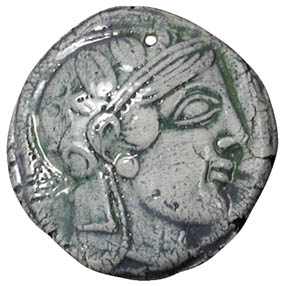
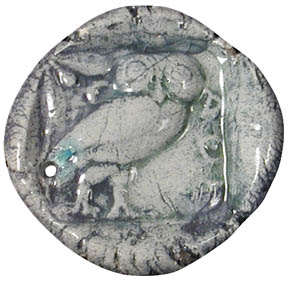
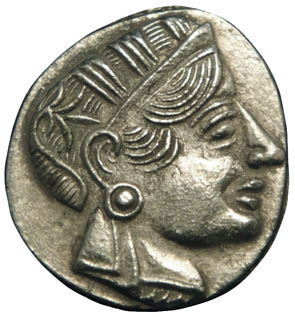
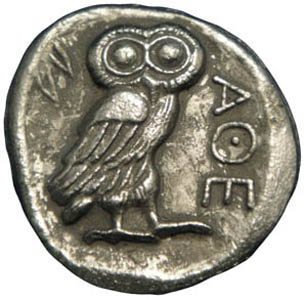
Turkish ceramic jewelry replica Classical Owl tetradrachm (3.0g). This is a work by Bekircan Tahberer of Sandan Art, originally based in Turkey, currently based in Vancouver, Canada. It's interesting for what it is, an inexpensive lightweight clay pendant meant to be worn on a necklace that was cast from a Mass Classical Owl, then baked in a kiln. |
|||||||||
 |
 |
||||||||
Jewelry replica Classical Owl tetradrachm (5.9g). This appears to be another jewelry replica, but without a hole. It was originally, and amateurishly, engraved, with an unrealistic helmet on Athena and a missing crescent moon on the reverse. It's thin and lightweight, probably made of pewter, and cast, with small casting pits and a pronounced edge seam. |
|||||||||
 |
 |
||||||||
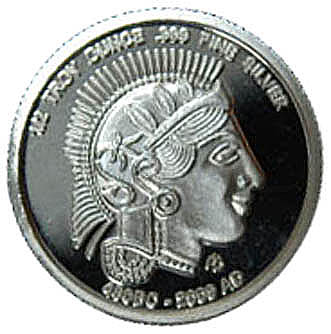
Silver round bullion replica Classical Owl tetradrachm (15.55g). As a bullion coin, this piece, minted by the Lydian Mint, a private mint in Ann Arbor, MI, is a way to attractively invest in silver. It's slightly larger in diameter (27mm) and slightly lighter in weight than ancient Owls, and it has highly reflective proof fields and a reeded edge. The LM monogram under Athena's chin is for Lydian Mint. Five thousand of these pieces were produced for the year 2009. The 480 BC date on the obverse corresponds to the first year that Early Classical Owls were thought to be minted, though the minting of the variety depicted on this piece, a Mass Classical Owl, was initiated slightly later. You can optionally buy these bullion coins in an NGC slab, titled "Private Issue Bullion," but the reverse -- the owl -- is treated as the obverse, facing front. The Lydian Mint also produces other attractive bullion coin designs in silver as well as gold of different sizes. |
|||||||||
|
|
|
|
|
|
|
|
|
|
|
|
|
|
||||||||
|
|
|
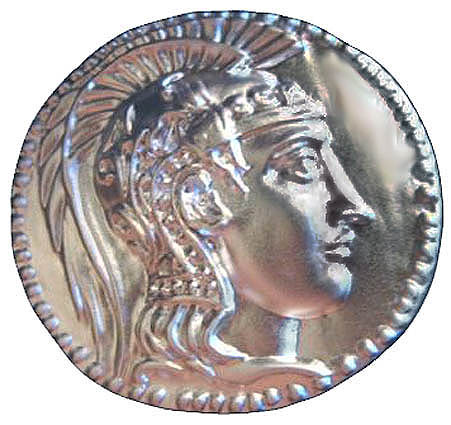
Mayer & Wilhelm 19th century electrotype replica Intermediate Style tetradrachm (16.7g). This silver-plated replica is from the same seller in Germany who sold the archaic Owl replica at the top of this page. It appears to be from the same hand as that Mayer & Wilhelm piece, though it shows evidence of the soft details of a cast, and it's likely a cast the original electrotype replica. Still, the above piece is attractively done, with a small, thick flan and attractive toning, and it's full weight despite being silver plated. As with the first piece, it has what appears to be the remnants of an edge seam. It copies an Intermediate Style Owl from c. 393-300 BC, Sear 2537. |
|
|
|||||
 |
|||||||||
 |
|||||||||
Shishido mule replica tetradrachm (21.3g, 37.5mm). This is a very curious oversize silver-plated mule replica that combines the obverse of a New Style Owl with the reverse of a Classical Owl of three centuries or so earlier, though the owl's small head is more akin to that on New Style Owls. Aside from its oddity, the piece is attractive enough in hand, with nice matted surfaces. Along with gold-plated pieces of the same type, it was sold on eBay through numerous auctions in 2009 by Don Shishido of Waipahu, HI, with his indicating that he produced 100 of these in silver, though many more have appeared since. In email he said he's a long-time collector but finds the "bulging" eyes of Athena on earlier Owls "grotesque," so he decided to create his very own ancient Greek coin. As an oversize, overweight mule that pairs mismatched design elements, it probably is unique, along with being disconcerting to the eye. |
|||||||||
|
|
|
|
|
|
|
|
|
|
|
|
|
|
||||||||
|
|
|
Slavey replica New Style Owl tetradrachm (16.9g). This high-quality, full-weight pressed replica, made of .950 silver, is another of Slavey's best works, with beautifully cut dies, careful minting, and attractive toning. Unlike the Slavey replica of the Classical Owl pictured earlier on this page, this replica is unmarked with "COPY." However, as the piece of art that it is, this specimen is signed, with a tiny "Slavey" signature in Cyrillic under Athena's neck (not visible in this photo). It copies a New Style Owl, Sear 2553. |
|
|
|||||
|
|
|
|
|
|
|
|
|
|
|
|
|
|
||||||||
|
|
|
Rosa/Doyle replica New Style Owl tetradrachm (10.6g). This lightweight silver-plated cast replica, made by Charles Doyle from Peter Rosa's molds, is not one of his better works. It's undersize and lightweight, and it's marred by muddy details and large casting pits, an ugly replica overall. This piece is countermarked with "COPY" on the edge (not visible in this photo). |
|
|
|||||
|
|
|
|
|
|
|
|
|
|
|
|
|
|
||||||||
|
|
|
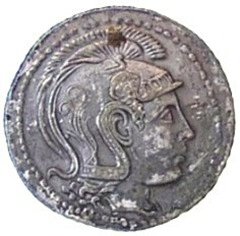
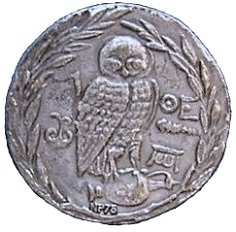
Nescafé replica New Style Owl tetradrachm (2.7g). This small, underweight piece was part of series of reproductions of ancient coins made in Germany in 1975 for Nescafé. It and similar pieces were attached to lids of Nescafé instant coffee jars as a promotion. With the NP75 countermark on the reverse, NP is short for the German word Nachprägung, which translates into restrike, and 75 is short for 1975, the year this piece was made. |
|
|
|||||
|
|
|
|
|
|
|
|
|
|
|


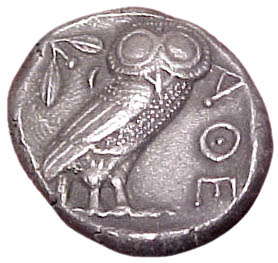
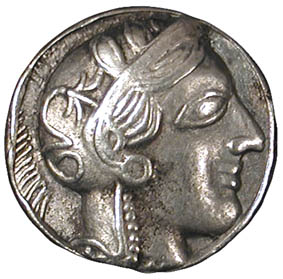
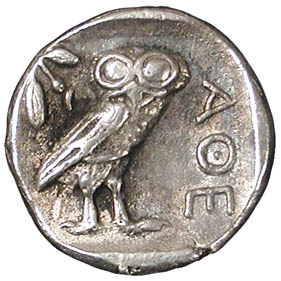
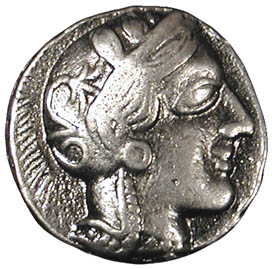

Other glomworthy coins:
Coin sites:
Coin Collecting: Consumer Protection
Guide
Glomming: Coin Connoisseurship
Bogos: Counterfeit Coins
Pre-coins
© 2013 Reid Goldsborough
Note: Any of the items illustrated on these pages that are in my possession are stored off site.